Optimizing Housing and Documentation for Study Abroad Programs
Organize housing and documentation for international students efficiently with this guide, improving your study abroad program management.


Confirmed housing and submitted documents do not automatically give a study abroad office a clear view of each participant. Dates may sit in a spreadsheet, the contract in a shared folder, and the latest change in an email only part of the team has seen.
The challenge is keeping those details connected throughout the program. Teams need to know what is confirmed, what remains outstanding, who should act, and which arrangements need attention when a stay changes.
This guide explains how to organize housing, documentation, and student follow-up across one or more destinations, with clear records, responsibilities, and handoffs.
Key Principles for Housing and Documentation
- Track housing capacity and availability for specific dates. Keep proposed options separate from confirmed reservations.
- Verify documentation requirements for the destination, institution, nationality, and program. A received file is not necessarily a reviewed or approved file.
- Link each participant to their program, destination, housing, dates, outstanding actions, and follow-up owner.
- Establish where current information is maintained and agree on shared status definitions.
- Use a consistent structure as participant numbers, programs, and destinations grow.
How to Manage Housing for International Students?
Managing international student housing means connecting accommodation, date-specific availability, participants, and confirmations. It also requires tracking documents and changes within the institution’s agreed role.
That role varies. A university may allocate residence hall spaces, coordinate bookings through partners, or provide guidance while students arrange their accommodation. These models require different levels of involvement and responsibility. Define who confirms availability, who finalizes the arrangement, and who handles problems. An available option, a proposal, and a confirmed reservation are distinct stages, not interchangeable labels.
-
Define the University’s Coordination Scope
Housing coordination may cover inventory, allocation, booking conditions, documentation, arrival, departure, and issue tracking. For each activity, identify whether the institution, a partner, or the student is responsible. If the office provides guidance only, make that distinction clear. If it allocates accommodation, it needs current evidence that the relevant room or bed is available for the agreed dates.
Students also require a clear contact and escalation route for matters outside the office’s scope. A defined handoff is part of coordination, even when another party delivers the service.
What Should a Student Housing Inventory Include?
A useful inventory identifies the accommodation, its capacity, date-specific availability, relevant conditions, responsible partner, and allocation status. Supporting documents and operational notes should remain linked to the relevant record.
Define the unit being allocated. A residence, an apartment, a room, and a bed are not equivalent. If the program assigns beds in shared rooms, track capacity at bed level to avoid counting the same space twice.
Accommodation Inventory Checklist
- Identification: a unique reference for the unit or bed, its location, and the operational contact.
- Accommodation type: residence hall, shared housing, room, apartment, or another defined category.
- Capacity: total and committed spaces, measured consistently.
- Availability: the period offered, when it was last confirmed, and who confirmed it.
- Stay dates: check-in, check-out, and any access restrictions.
- Financial conditions: relevant accommodation costs, deposits, included services, and change policies.
- Partner: the responsible organization, contact details, and escalation process.
- Allocation: the linked participant and whether the arrangement is proposed, in progress, or confirmed.
- Documentation: applicable terms, booking confirmation, and contract.
- Operational notes: necessary accessibility, maintenance, or incident information, with appropriate access restrictions.
-
Separate Capacity from Date-Specific Availability
A residence can have substantial capacity and still have no spaces available during the program period. Planning must account for dates and accommodation type, not just the property name. Distinguish “availability awaiting confirmation” from “confirmed availability.” Record the source and date of the confirmation so an old conversation does not become a current commitment.
How a Study Abroad Office Should Organize Documentation
Start by defining what the program requires, who requests each document, who submits it, and who reviews it. Link every item to the relevant participant and program, with a clear status and deadline where applicable.
Requirements vary by country, institution, nationality, program, and individual circumstances. Relevant categories may include enrollment, identification, housing, insurance, institutional forms, and immigration documents. They are not a universal checklist.
-
Keep Review Processes Distinct
Academic records and enrollment forms serve a different purpose from housing confirmations and contracts. They can belong to the same operational case while retaining separate reviewers and approval processes. Connecting records should improve visibility, not merge responsibilities that belong to different departments or specialists.
-
Use Statuses That Explain Progress
Agree on what each status means before using it across teams:
- Requested: the participant has been asked to submit the document.
- Received: the file has been submitted.
- Pending review: the designated reviewer still needs to check it.
- Action required: missing or incorrect information needs attention.
- Reviewed or complete: the item meets the criteria defined by the responsible department.
Document review must remain separate from any external approval. An uploaded or reviewed immigration document does not establish that a visa or permit has been approved. For every outstanding item, record the next action, responsible person, and review date. Confirm immigration requirements with qualified specialists and the relevant authorities rather than copying assumptions from a previous case.
-
Centralize Tracking Without Sharing Every Document
A housing coordinator may need an arrival date or a review status without needing access to the full immigration file. Define access according to purpose. Review retention, security, and disposal with the responsible departments, including applicable data protection obligations. Where appropriate, a shared record can show progress without reproducing sensitive documents.
Centralization does not mean unrestricted access, and it does not by itself establish compliance.
How to Connect Students, Documents, and Housing
Link each participant to the relevant program, destination, stay dates, accommodation, documents, and outstanding actions. Make clear where current information is maintained and who updates it. Everything does not need to be copied into one spreadsheet. Related records can preserve the connections between participants, accommodation, documents, and follow-up without duplicating every detail.
Separate the person from each program participation. If a student joins two programs, the housing and dates for one must not overwrite those for the other. When a change occurs, review its dependencies. A revised departure date may require updates to the accommodation arrangement, program record, and follow-up plan. Assign those actions rather than assuming the change will reach everyone.
Why Fragmented Records Create More Work
An email thread preserves a conversation but may not identify the final decision. A folder stores files but does not explain whether they have been reviewed. Separate spreadsheets can contain different dates without showing which version is current.
The consequence is repeated verification before anyone can act. Handoffs become harder when the next team member must reconstruct the case from files and conversations. More columns do not solve unclear ownership. Continuity requires shared status definitions, update rules, and named responsibilities as programs become more complex.
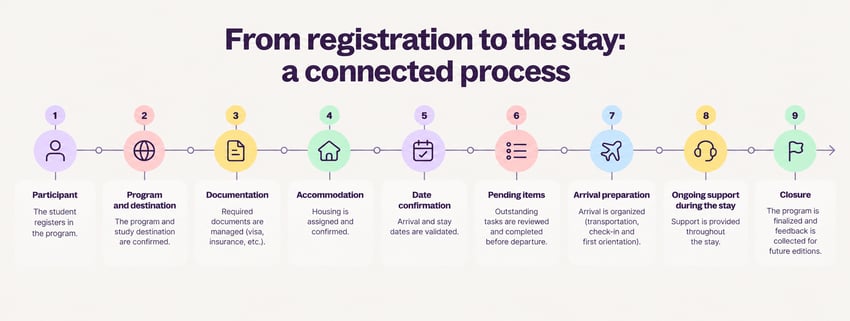
A Practical Workflow for Housing and Documentation
Adapt this workflow to the institution’s role and program requirements. Some activities can run in parallel; others depend on earlier confirmations.
1. Register the participant
Create a consistent participant record using the information needed for coordination. Check for duplicates and define how corrections will be made.
2. Link the program, destination, and period
Record the program, relevant institution, destination, and planned dates. Separate different locations or periods, and label provisional plans clearly.
3. Identify and request required documentation
Specify the requirements, submission channel, reviewer, and status for each item. Document collection can proceed alongside housing coordination when the program permits it.
4. Propose, allocate, or record housing
Follow the agreed model: propose accommodation, allocate a space, or record a student’s independent arrangement. Distinguish a proposal from a booking in progress and a documented confirmation.
5. Check dates and confirmations
Compare academic, travel, and accommodation dates. They may differ. Record who issued each confirmation and define the next action for any discrepancy.
6. Review outstanding actions
Check housing, documents, and other pending work for each case. Describe what is missing, who should act, and when progress will be reviewed. “To be resolved” is not enough for prioritization or a handoff.
7. Prepare for arrival
Confirm access instructions, accommodation contacts, expected arrival times, and any included arrival services. Make unresolved details visible before travel.
8. Follow up during the stay
Record changes to dates, accommodation, or support needs. For issues within the program’s scope, identify the responsible party and next action. For matters outside it, document the handoff and contact route. Housing follow-up continues beyond the initial booking confirmation.
9. Close the case
Check departure details, outstanding actions, and final records against the agreed responsibilities. If an issue remains open, name the party continuing the follow-up. Apply the institution’s retention and disposal policy. Document handling should not depend on an improvised decision at the end of the stay.
Checklist for Reducing Manual Follow-Up
Clear operating rules come before centralization. Use this checklist to establish a consistent foundation:
- Define where current information is maintained for each process.
- Use consistent references for participants, program participation, and accommodation.
- Separate planned, confirmed, and actual dates where relevant.
- Agree on the evidence required for a confirmed status.
- Link documents and housing to the correct case.
- Assign an owner and next action to every outstanding item.
- Record who reported a change and when it was reviewed.
- Stop using outdated copies as active reference points.
- Share only the information each party needs.
- Review requirements, outstanding actions, and open issues regularly.
These practices can work in a manual process. A connected platform can help maintain them when coordination spans more participants, teams, and destinations.
How Floweal Desk Connects These Processes
For study abroad and international relations offices, Floweal Desk connects program and participant management with housing, documentation, and operational follow-up in one platform.
Teams can centralize these elements while maintaining a connected view by program and destination. The purpose is to understand each participant’s situation and coordinate the work without reconstructing it across separate records and conversations. The institution’s coordination scope, departmental review responsibilities, and partner obligations still need to be defined. Shared visibility supports those responsibilities; it does not replace them.
Frequently Asked Questions
-
What Should an International Relations Office Centralize? Connect participants, programs, destinations, dates, housing, documents, and outstanding actions. Identify what the office coordinates, what other departments review, and what partners deliver. The shared view should allow another team member to continue the case without rebuilding its history.
-
Does a Housing Inventory Confirm Availability? No. An inventory identifies accommodation, but availability requires current information for the relevant dates and capacity. Record the confirmation source and date, and keep proposed accommodation separate from confirmed reservations.
-
Which Documents Does Each International Student Need? There is no universal list. Requirements depend on the destination, institution, nationality, program, and individual circumstances. Verify them with the responsible departments and relevant specialists. Keep submission, review, and approval statuses distinct.
-
Can Follow-Up Be Managed Without a Specialized Platform? Yes. Manual processes can work when volume and complexity are manageable and responsibilities are clear. As coordination becomes more demanding, a platform can connect records and make outstanding work easier to follow across teams.
-
What Does Floweal Desk Add to a Study Abroad Program? Floweal Desk connects programs, participants, housing, documentation, and follow-up in a shared environment. It helps teams reduce information fragmentation and coordinate around each participant’s case.
Connect Your Study Abroad Operations with Floweal Desk
Bring a representative program to a Floweal Desk demo. Review how participants, housing, documents, and follow-up connect, and define the scope around your destinations and coordination model. Discover how Floweal Desk can support your study abroad operations.
We make it flow.
Explore this topic