International Student Housing: Why Waiting Is Still a Decision
Discover why early housing decisions for international students are crucial for reducing stress, costs, and operational challenges during their transition.


Academic calendars operate on fixed dates. Students arrive in cohorts. Housing inventory in destination cities does not expand to match delayed decisions.
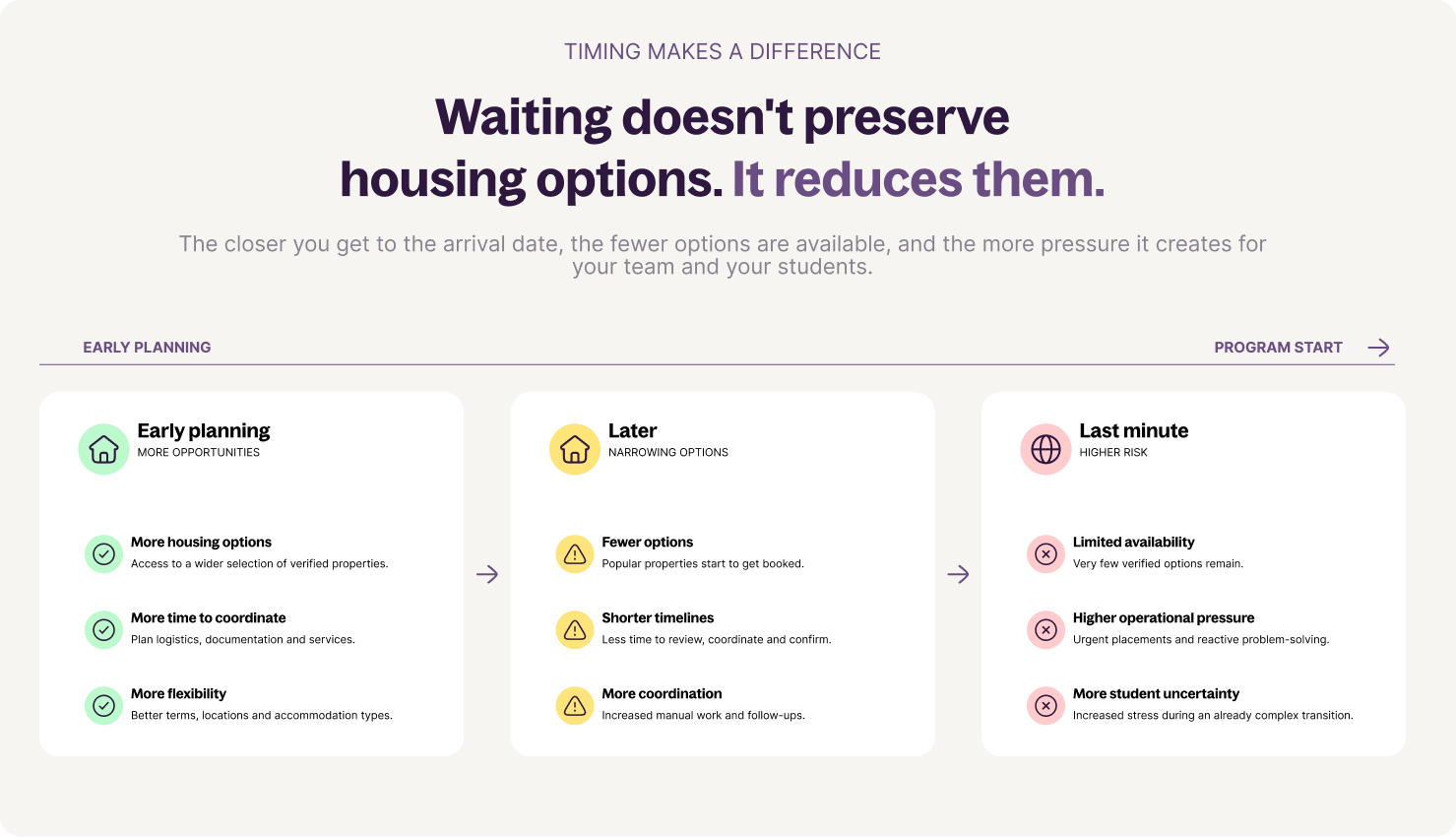
When institutions postpone housing coordination, verified properties with documented ownership and B2B-ready terms disappear. Operators allocate inventory based on confirmed bookings, not potential future demand. As arrival dates approach, the pool of available housing narrows—and what remains often carries shorter lead times, less favorable terms, or locations farther from campus.
The calendar moves regardless of internal readiness. Waiting does not preserve options. It consumes them.
Delayed Housing Decisions Create Operational Expenses
Postponing housing decisions shifts the operational burden from planned coordination to reactive problem-solving. Teams compress weeks of structured matching into days of urgent placement. Manual searches multiply. Email volumes increase. Case managers spend time chasing availability instead of supporting students through onboarding.
Late decisions also transfer risk to the students themselves. Compressed timelines mean fewer housing choices, higher dependency on last-minute availability, and increased stress during an already complex transition. Students face uncertainty about where they will live while managing visa applications, travel logistics, and academic preparation.
These costs do not appear on a balance sheet. They emerge as longer response times, increased coordination overhead, and diminished control over the student experience. Waiting converts planned operations into crisis management.
What Changes When International Student Housing Is Planned Earlier
Earlier housing decisions expand operational flexibility. Teams gain time to match students with verified inventory, coordinate move-in logistics, and resolve documentation requirements before arrival pressure builds. Providers respond to confirmed demand with structured timelines. Students receive housing confirmations early enough to focus on travel, compliance, and academic readiness.
Planning windows also enable better coordination across the full mobility cycle. When housing is confirmed early, teams can layer in local services, schedule airport transfers, and sequence onboarding activities without compressed deadlines. The entire process flows rather than reacting.
Floweal Desk centralizes housing coordination, document collection, and program management in one workspace. Organizations track housing confirmations, student progress, and arrival timelines from a single dashboard. The platform connects verified housing inventory directly to mobility programs—reducing manual coordination and providing visibility into what is confirmed, pending, or unassigned. Timing becomes a strategic variable, not a source of operational friction.
FAQs
-
What happens if we delay housing decisions until closer to the program start date? Inventory availability decreases as verified properties are booked by other programs or institutions. Delayed decisions compress coordination timelines, increase manual workload, and reduce housing options for students.
-
How early should international student housing be planned? Housing should be coordinated as soon as cohort sizes, destinations, and arrival dates are confirmed. Earlier decisions provide access to broader inventory, more favorable terms, and structured coordination timelines.
-
Can housing be secured quickly if needed? Last-minute placements are possible but depend heavily on current inventory availability, destination city capacity, and provider responsiveness. Compressed timelines reduce options and increase operational costs across the mobility workflow.
We make it flow.
Explore this topic