What to Look for in Effective Relocation Management Software
Discover essential features for choosing relocation management software that enhances efficiency and visibility in corporate housing operations.


A confirmed apartment does not tell a mobility team whether an assignment is ready. Documents may still need review, arrival dates may change, services may remain unconfirmed, and payment responsibilities may sit in a separate system.
The coordination problem appears between those records. Your team needs to know what is agreed upon, what is pending, who must act, and which other parts of the move are affected. Replacing a spreadsheet without connecting those relationships can leave the same manual work behind.
This article explains what to look for in relocation management software, from connected workflows and document tracking to housing, services, communication, and reporting.
Why relocation management must connect more than housing
Employee relocation management connects assignment details, accommodation, documents, services, payments, and support around the person moving. Housing is one component, but changes can impact several others. A useful platform should make those dependencies visible and trackable, with clear ownership, rather than leaving the team to reconstruct the case across separate systems.
A later arrival may require checking accommodation access, transport, and the agreement supporting the stay. A missing document may need specialist review before another action proceeds. These situations require coordination, but they do not all require the same response.
Fragmented operations make the relationships harder to see. The buying question is which handoffs the proposed platform connects, which remain external, and how exceptions are followed through to a documented outcome.
Property operations, accommodation discovery, and mobility coordination
Property management systems focus on accommodation operations; discovery platforms help identify or book options; global mobility platforms organize cases and related processes. These categories often overlap, so the key is understanding how each solution fits into the broader mobility operation and which processes remain connected.
| Model | Primary focus | What to verify | Possible role in the operation |
|---|---|---|---|
| Property operations system | Units, calendars, bookings, and property-related work | Connection to assignment records, documents, institutional clients, and resident support | Accommodation-side system that may be retained or connected |
| Accommodation discovery or booking platform | Finding options and progressing housing decisions | Post-booking support, contractual scope, reporting, and case-level updates | Sourcing or booking a channel within a broader mobility process |
| Global mobility platform | Cases, participants, coordination, and program visibility | Operational depth, external handoffs, service execution, and integrations | Coordination environment relating to the different parts of a move |
A property system can include resident communication. A booking service can include ongoing support. A mobility platform can depend on external execution. The most useful comparison is therefore based on the actual workflow and scope of each solution rather than its category alone.
Which global mobility platform features should buyers evaluate?
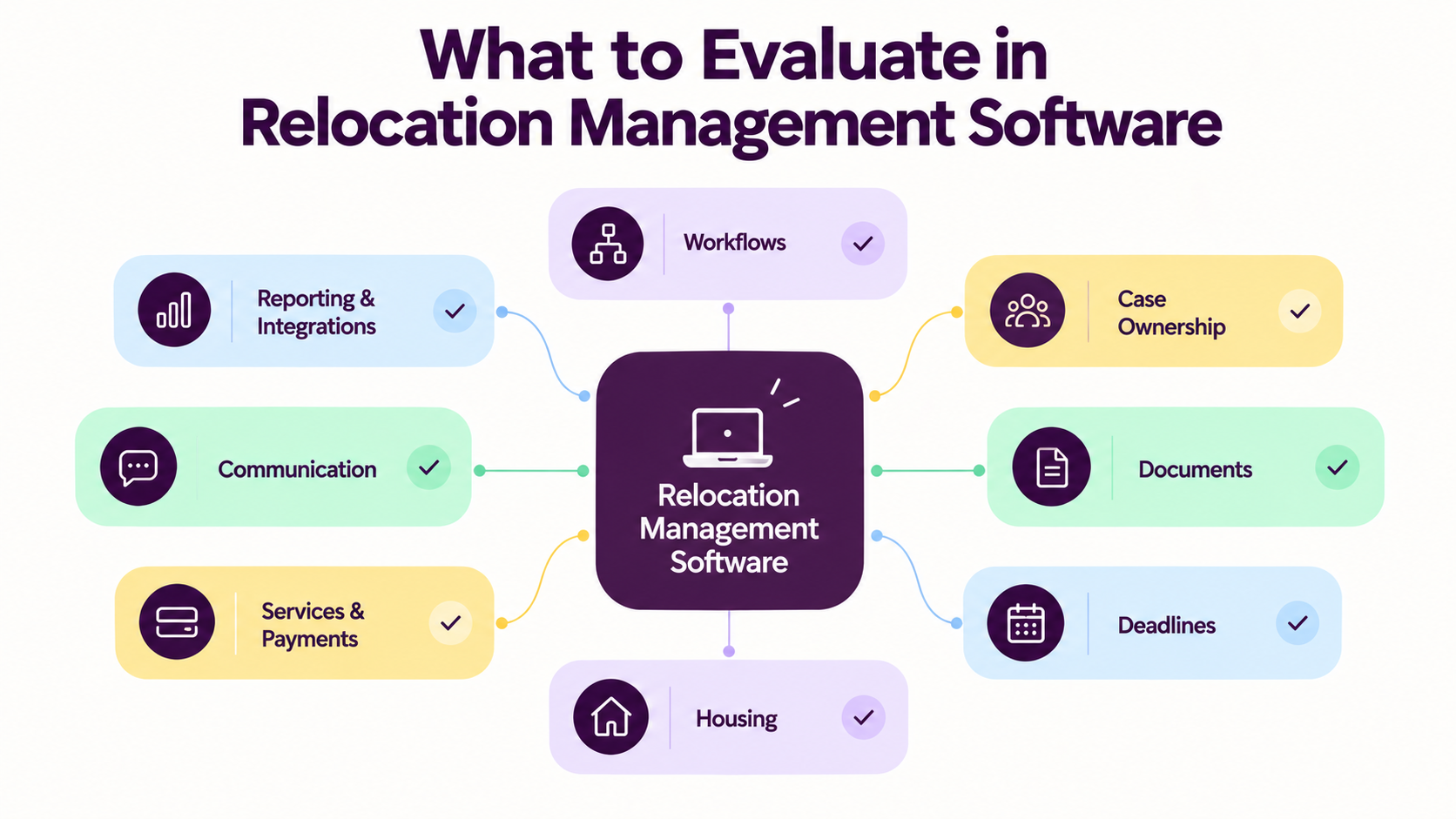
Buyers should evaluate case workflows, document tracking, deadlines, inventory coordination, services, financial visibility, communication, and reporting. Integration and data governance connect those capabilities to the existing operation. The right scope depends on the program, destinations, and actors involved, so evaluating these capabilities through representative cases gives teams a clearer view of operational fit.
-
Flexible workflows and clear case ownership
Workflows should support the variations your team actually manages: assignment type, destination, approval responsibility, and service scope. The evaluation should distinguish configurable processes from changes that require additional implementation work.
Test whether another coordinator can continue a case with sufficient context. Manual review can be appropriate; the issue is whether the owner, decision, and next action remain visible. The priority is maintaining enough context for another coordinator to understand the decision, owner, and next action.
-
Documents, deadlines, and evidence
Document status should make it clear whether a file has simply been received or has already completed the corresponding review. Also distinguish delivery deadlines from document expiry and internal review dates. Ask how a corrected document or changed assignment affects follow-up. Deadlines should remain connected to the type of document, its validity, and the corresponding review process.
-
Inventory, services, and financial coordination
Housing coordination should relate availability and conditions to the required dates and profile. Housing information should connect availability, conditions, dates, and participant needs so teams can evaluate suitable options with current information.
For services, distinguish requested, confirmed, and delivered. For financial records, distinguish quoted, invoiced, paid, and outstanding. A confirmed booking may legitimately remain unpaid under agreed terms; visibility should explain that situation rather than treat the two states as contradictory.
-
Participant communication and support
The participant needs to understand outstanding actions, arrival arrangements, and support contacts. The organization requires visibility into communications relevant to its responsibilities. Evaluate how updates reach both sides without requiring unnecessary access to personal information.
A single application may help, but not every communication channel must disappear. What matters is how material decisions and changes enter the case record. Post-booking support illustrates why continuity remains important after accommodation is confirmed.
How to compare relocation management software with real cases
To compare relocation management software, bring representative cases and define the decisions, records, and roles that each scenario must expose. Observe the workflow in a demonstration or controlled pilot, including external steps. Record what is available now, what needs configuration, and what requires another system or service.
| Scenario | What to examine | Evidence to request |
|---|---|---|
| Arrival date changes after housing confirmation | Effect on accommodation, services, communication, and dates | Updated record, responsible actor, and outstanding confirmations |
| A required document is missing or needs correction | Applicability, request, review, and follow-up | Document state, review owner, and next action |
| A stay extension overlaps a later commitment | Availability, decisions contractual and financial effects | Request separated from approval and confirmed changes |
| A housing incident involves several actors | Escalation, support, and service responsibility | Case context, communications, and resolution follow-up |
Use anonymized or synthetic information during evaluation unless real data sharing has been appropriately authorized. When possible, use anonymized or synthetic information during the evaluation to protect participant data.
-
Record configuration and manual steps honestly
Configuration and manual steps should be documented as part of the evaluation, making clear what is supported by the platform and what remains an external handoff. Compare the same scenario across options and retain a written record of what was shown. A proposed roadmap item should not be scored as an available function, and a general product claim should not replace demonstration evidence.
Floweal's modular approach to mobility coordination
At Floweal, we connect organizational coordination, accommodation operations, specialized services, and the relocated person's experience through one modular ecosystem. Desk, Management, Services, and Go address different parts of the mobility journey while keeping them connected.
-
Desk: coordination for organizations
Floweal Desk gives organizations a central environment to manage programs, participants, accommodation, documentation, and services. It helps teams maintain visibility across mobility processes while keeping each participant, pending action, and responsible actor connected to the broader program.
-
Management: accommodation inventory and operations
Floweal Management centralizes accommodation calendars, bookings, contracts, and financial operations while connecting housing supply with institutional demand across the Floweal ecosystem. This helps operators coordinate property availability and stays with the needs of universities, companies, and mobility programs.
-
Services: specialized partner coordination
Floweal Services connects mobility programs with specialized partners across areas such as legal support, insurance, transport, and local services. This allows organizations to coordinate additional needs within the broader mobility journey while maintaining clear responsibilities between the teams and specialists involved.
-
Go: the participant-facing experience
Floweal Go brings the participant into the connected mobility experience, providing them with access to accommodation, bookings, documents, services, and communication throughout their journey. Together, Desk, Management, Services, and Go connect the different actors involved without treating each part of mobility as an isolated process.
Frequently asked questions
-
Is relocation management software different from a global mobility platform? The terms can overlap. Their names do not prove scope: some products focus on cases or particular services, while others connect broader program operations. Compare the actual relationship between participants, documents, housing, services, and support. At Floweal, our modular approach connects participants, organizations, accommodation operations, and specialized services across the mobility journey.
-
Does a housing booking platform replace mobility coordination? Not necessarily. Booking accommodation addresses one part of the move; documents, services, approvals, and ongoing support may require other processes. Some booking products offer a wider scope, so verify the specific service. The comparison should focus on remaining handoffs, not assume every product in a category has the same limitations.
-
Can a platform replace immigration or legal specialists? A platform can organize documents, deadlines, and coordination, but that does not establish authority to interpret every legal requirement or replace qualified advice.
See how Floweal fits your mobility operation
If your team is managing participants, accommodation, documents, services, and multiple stakeholders across disconnected tools, Floweal brings those processes into a connected mobility ecosystem. Explore the platform or request a demo to see how it can support your operation.
We make it flow.
Explore this topic