Top 7 Global Mobility Platforms to Consider in 2026
Explore the top global mobility platforms for 2026, designed to streamline relocation processes and enhance coordination for corporate mobility teams.


Relocation coordination breaks down when each part of the process lives in a different system. Housing is confirmed by email, immigration documents sit in another application, and progress depends on a spreadsheet someone must keep updated.
As the number of participants, programs, and destinations grows, teams spend more time reconstructing the case: what is confirmed, what is missing, and who needs to act. Digitizing mobility requires more than replacing paper files. It requires connecting information, responsibilities, partners, and services.
This article compares seven global mobility platforms by operational approach. The aim is to help organizations build a relevant shortlist, not declare a universal winner.
Global Mobility Platforms at a Glance
The platforms below address different needs, from program coordination and corporate assignments to destination services and immigration. Their order is not a ranking.
- Floweal Desk: connects mobility programs, participants, housing, documentation, and services.
- Equus Platform: supports corporate assignments, relocations, and other mobility scenarios.
- Topia: combines mobility planning, tracking, and cross-border risk management.
- Relocity One: connects partners, services, and milestones with a digital experience for relocating employees.
- ReloTalent: supports relocation service companies and their collaboration with corporate clients.
- xpath.global: brings cases, documents, tasks, partners, and service requests into a shared environment.
- Deel Mobility: focuses on immigration cases, documentation, deadlines, and specialist support.
A global mobility platform is a digital environment for coordinating and tracking international moves. Depending on its scope, it can connect people, cases, documents, housing, services, and partners.
“Mobility management” does not mean the same thing across every product. Tracking an immigration case addresses a different need from coordinating housing, arrival, and support during a stay. The practical distinction is what the platform connects and what still happens outside it. A shared dashboard alone does not establish that every participant works from connected, current information.
Why Move Beyond Spreadsheets?
Spreadsheets become difficult to maintain when they serve as the link between email, housing arrangements, immigration systems, and document archives. They can record information, but teams still need to communicate changes and check that each party has the latest version.
A revised arrival date may affect housing, transportation, documentation, and internal planning. Without an agreed source of current information, those activities can follow different schedules. Adding staff can increase capacity. It does not resolve scattered information or unclear ownership. Operational scalability depends on maintaining visibility and continuity as case volume grows.
What to Evaluate in a Global Mobility Platform
Start with the processes your organization needs to connect. Then distinguish between platform capabilities, included services, and work delivered by specialist partners.
- Cases and participants: how individual records connect to programs, assignments, and pending actions.
- Housing: whether the platform records a requirement, coordinates a search, or connects users with verified accommodation.
- Documentation and immigration: how files and deadlines are tracked and who provides specialist advice and application support.
- Services and partners: who requests, confirms, delivers, and updates each activity.
- Communication: what internal teams, relocating people, and partners can see and act on.
- Reporting: which reports can be produced from connected data without manual reconstruction?
- Destinations and integrations: which services are available in each location and which connections to existing systems are supported.
Personal documents also require clear access, purpose, and retention rules. Assess applicable data protection obligations, including the GDPR where relevant. Using a platform does not, by itself, establish compliance.
How to Read This Comparison
This comparison distinguishes operational approaches rather than scoring every platform against an identical feature list. Product capabilities and services can vary by plan, market, implementation, and contracted scope. The evaluation considers six dimensions:
-
Operational focus: program coordination, corporate mobility, relocation service delivery, or immigration.
-
Primary users: corporate teams, specialist firms, organizations, and relocating participants.
-
Cases and services: the relationship between digital tracking and service delivery.
-
Housing: the difference between recording accommodation, coordinating access, and confirming availability.
-
Collaboration and documentation: how parties share information and follow progress.
-
Centralization: which activities are connected and which responsibilities need contractual clarification.
Descriptions of third-party products should be checked against current official documentation and confirmed during evaluation. A capability not described here should not be treated as unavailable.
7 Global Mobility Platforms to Evaluate in 2026
1. Floweal Desk: Connected Programs, Housing, and Services
Floweal Desk is our workspace for organizations managing international mobility programs. It centralizes participants, housing, documentation, services, and follow-up within a connected operation.
Desk connects with Floweal Management for accommodation inventory and operations, and with Floweal Go for the relocating person’s housing search and stay. This links program oversight with the activities of accommodation operators and participants.
-
Approach: organizational mobility coordination within the Floweal International Mobility Hub.
-
Core scope: programs, participants, housing, documentation, services, and follow-up.
-
Key distinction: connection between program management, accommodation operations, and the participant experience.
-
Confirm during evaluation: destination coverage, required services, integrations, and operational support.
Where additional coordination is needed, operational support can be defined within an agreed scope. Platform coordination, partner service delivery, specialist immigration advice, and authority decisions remain distinct responsibilities.
2. Equus Platform: Corporate Assignments and Mobility
Equus Platform supports corporate mobility scenarios such as assignments, relocations, international hiring, business travel, and remote work. Its approach brings together policy, compensation, immigration, documentation, and tracking.
The platform connects data and stakeholders through the Equus Ecosystem. Service coordination should be assessed separately from housing availability or the delivery of legal advice.
-
Approach: corporate mobility management.
-
Core scope: assignments, people, documents, immigration cases, partners, and reporting.
-
Key distinction: management of multiple mobility scenarios alongside assignment policies and compensation information.
-
Confirm during evaluation: included partner connections, housing coordination, destination services, and specialist support.
3. Topia: Mobility Planning and Cross-Border Risk
Topia connects international assignments, business travel, and remote work with employee location and corporate policies. Its approach serves mobility, HR, finance, and compliance teams through planning, cost estimates, tracking, and reporting.
Tax and immigration checks support the assessment of cross-border work. They should not be confused with legal representation or approval by the relevant authorities.
-
Approach: mobility planning and cross-border risk management.
-
Core scope: assignments, travel, remote work, documents, costs, immigration tracking, and reporting.
-
Key distinction: linking mobility scenarios to work location, policies, and planning.
-
Confirm during evaluation: corporate system connections, partner responsibilities, accommodation coordination, and specialist service delivery.
Housing inventory or booking services should be verified separately rather than assumed from the platform’s wider mobility scope.
4. Relocity One: Partner Coordination and Employee Experience
Relocity One connects relocation partners, services, and milestones through a customizable digital experience. Its approach combines program visibility with the relocating employee’s access to information and support.
Relocity’s offering includes a mobile experience and different levels of remote guidance or in-person assistance. The housing, immigration, tax, and moving services available depend on the relationships and scope included in the program.
-
Approach: relocation service coordination and digital employee experience.
-
Core scope: moves, milestones, partners, housing coordination, communication, and reporting.
-
Key distinction: brand customization and connection with existing service relationships.
-
Confirm during evaluation: support levels, document management, signatures, immigration responsibilities, and destination coverage.
5. ReloTalent: Operations for Relocation Service Companies
ReloTalent, part of the Equus Group, is designed for companies delivering relocation services. It connects operational teams, immigration departments, corporate clients, and relocating people.
Its corporate portal supports assignment tracking, service requests, document sharing, and metrics. The emphasis is on giving clients visibility into the work coordinated by the service company.
-
Approach: operational management for relocation specialists and their clients.
-
Core scope: cases, services, participants, documents, communication, and reporting.
-
Key distinction: client collaboration through the company managing the relocation service.
-
Confirm during evaluation: access configuration, workflows, housing and immigration service scope, and any relationship with other Equus products.
Housing and legal support depend on the services delivered by the relocation company and its partners, not simply on access to the platform.
6. xpath.global: Cases, Partners, and Mobility Services
xpath.global connects cases, tasks, documents, partners, costs, and an assignee portal. Its approach combines case coordination with access to immigration and relocation services delivered by specialists and local partners.
Case timelines link responsibilities, milestones, and supporting documents. Electronic signatures and partner requests form part of the shared coordination environment described in the source material.
-
Approach: case management with coordinated mobility services.
-
Core scope: participants, documents, tasks, partners, reporting, immigration, and destination services.
-
Key distinction: connection between the case record, the assignee experience, and requests to service partners.
-
Confirm during evaluation: service delivery by jurisdiction, accommodation arrangements, data hosting, and contractual responsibilities.
An international partner network does not establish identical service availability or operational scope in every destination.
7. Deel Mobility: Immigration Tracking and Support
Deel Mobility focuses on immigration, visas, and permits for organizations and individuals moving internationally. Its scope includes case management, document tracking, deadlines, and specialist support. It can be relevant when the main priority is centralizing immigration records and connecting them with international employment processes. Tracking a case and assigning its execution are separate decisions.
-
Approach: immigration-focused platform and services.
-
Core scope: cases, documents, deadlines, immigration information, and specialist support.
-
Key distinction: centralized visibility into immigration cases involving different responsible parties.
-
Confirm during evaluation: third-party case tracking, available specialist services, destination coverage, and application support.
Assess housing and local services separately. Capabilities from other Deel products should not automatically be attributed to Deel Mobility.
Platform, Spreadsheets, and Specialized ServicesA spreadsheet records information. A platform structures coordination and follow-up. A specialist company delivers advice, implementation, or support within its service scope. These models can work together.
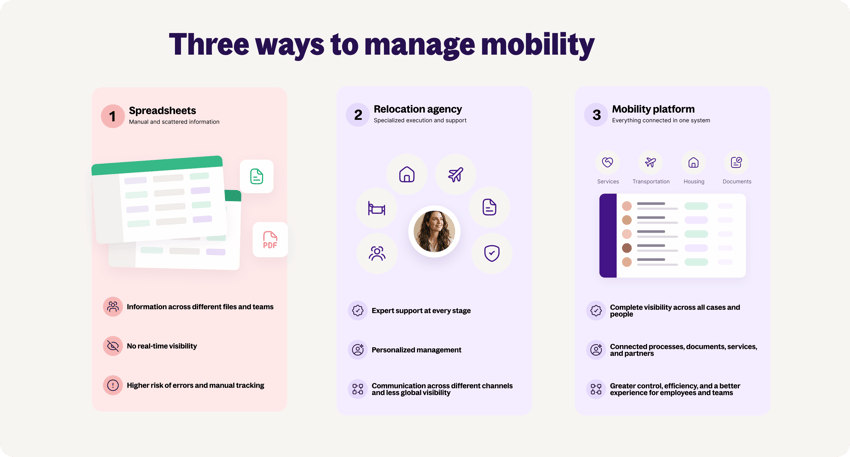
A relocation firm may use a platform to give clients visibility. A corporate team may retain external specialists while centralizing oversight. The decision is who should perform each activity and what information the organization needs to retain.
Integrations can connect those activities with existing systems, but an API-first architecture is not proof that a particular connection is ready. Confirm the data exchanged, its direction, update responsibilities, and implementation requirements.
How to Choose for Your Operating Model
Define the people, destinations, services, partners, and reporting requirements your organization manages. Use that operating model to build a shortlist before comparing secondary features.
-
Identify Where Coordination Breaks Down
Start with the point where continuity is lost: immigration documents, housing updates, partner communication, or reporting. That determines which operational approach deserves attention first. If housing is part of the program, review verification, booking conditions, availability, and support during the stay. Recording accommodation in a case does not mean its delivery is included.
-
Test Changes, Ownership, and Escalation
Bring a representative case to the demonstration. Test three situations: An arrival date changes after services are arranged. A required document remains outstanding. A housing issue is reported during the stay.
Check who receives the update, what changes in the record, and how another team member continues the work. Ask who coordinates escalation and who is responsible for resolving the issue.
-
Review Integrations, Reporting, and the Participant Experience
List the applications you need to retain, the information that must move between systems, and the reports your team uses. Verify specific connections rather than relying on a general integration list. Then review the relocating person’s experience. How do they see pending actions, access information, and request assistance? Operational continuity extends beyond booking and arrival.
Evaluate Floweal Desk with a Real Mobility Case
If participants, housing, documentation, and services are managed across disconnected systems, bring that process to a Floweal Desk demo.
Review how the activities connect, which responsibilities remain with your team and partners, and what additional coordination support your program requires. Define the scope around your actual destinations and operations. Request a demo to see how Floweal Desk fits your mobility programs.
Source note: This article is based on the supplied comparison, which references public information and official product websites for Equus Platform, Topia, Relocity, ReloTalent, xpath.global, and Deel Mobility reviewed in September 2026. Product features and services may change and should be confirmed directly before purchase or implementation.
We make it flow.
Explore this topic