Streamlining Rental Issue Management: From Report to Resolution
Optimize rental issue management by improving communication and follow-up processes for property teams and owners, ensuring seamless resolutions.


A quick reply does not mean a rental issue is being managed. A resident may report a problem through WhatsApp and receive an immediate acknowledgment, while the team still needs to establish who is coordinating the response, what has been confirmed, and what happens next.
WhatsApp, email, and phone calls can all support that communication. The operational difference is whether follow-up depends on reconstructing conversations or on a shared case record that another person can pick up. This article compares those approaches for property operators and owners. It explains what information an incident needs, how to preserve continuity between shifts, and what must happen before a case can be closed.
Receiving a Report and Managing a Case Are Different
Receiving a report makes the team aware of an issue. Managing a case means connecting that issue to the property, stay, responsible people, actions, and outcome until the resolution has been verified and communicated.
“We’ll look into it” communicates intent. It does not confirm that someone has accepted the assignment, that a visit is scheduled, or that a repair is complete. Follow-up must distinguish those stages.
Fragmentation begins when decisions and updates remain scattered across messages, notes, and individual team members. A shared record provides a reference point without requiring the team to abandon the channel used to report the problem.
Keep Useful Communication Channels, but Connect the Decisions
A message can report a new development. A phone call can clarify access arrangements. An email can provide supporting documents. Each channel can remain part of a structured process.
The team needs a consistent procedure for adding relevant information to the case: decisions, confirmed appointments, pending conditions, actions taken, and evidence. Record the source when it helps explain the decision or sequence of events. There is no need to transcribe every conversation. The goal is to preserve enough context for someone else to continue the work without asking the resident to start again.
Scattered Conversations vs. a Shared Case Record
A conversation follows the order in which messages arrive. A case record organizes information around the incident, its current status, and its next action. Clear agreements can exist in a chat or email thread. The risk arises when the team has no reliable way to locate them, establish which update is current, or identify who must act next.
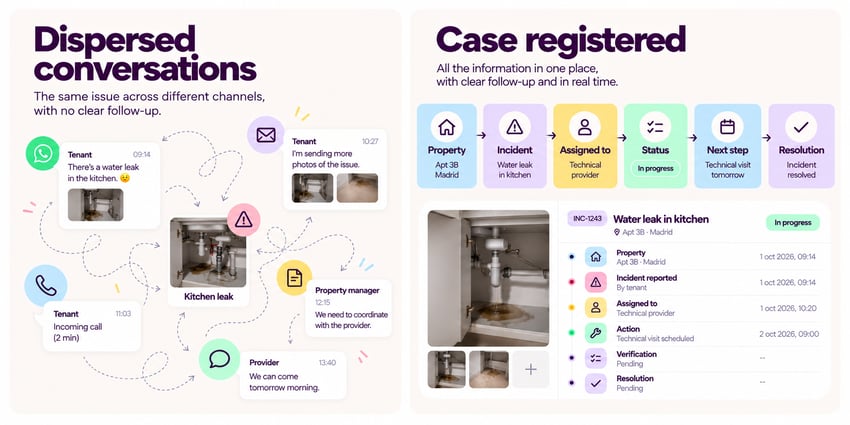
A shared record only supports continuity if it stays current and forms part of daily work. Creating a log without maintaining it adds another source to reconcile.
What an Incident Needs to Move Toward Resolution
Each case needs enough information to support review and action. The level of detail should match the issue; residents should not be expected to provide a technical diagnosis or unnecessary documentation. Record:
- Location: the affected property, unit, room, or common area, with a case reference.
- Context: what is happening, when it began, its observed impact, and the associated stay where relevant.
- Responsibilities: who coordinates follow-up, who performs the work, and who authorizes it where required.
- Status: the current situation, using definitions the team understands.
- Next action: what must happen, who will act, and when it will be reviewed.
- History: the decisions, interventions, and communications that explain progress.
- Outcome: what was done, how it was verified, and what was communicated.
A status such as “Awaiting visit confirmation” or “Blocked: access not arranged” explains a dependency. A broad label such as “In progress” should not conceal a missing approval or an unconfirmed appointment. Urgent issues also need an appropriate response and escalation procedure. Routine documentation should not delay immediate action when it is required.
Maintain Continuity Between People and Shifts
A handoff requires more than a complete message history. The incoming team member should find a current summary, completed actions, pending commitments, relevant contacts, and a clear next step.
Before transferring responsibility, check:
- Which cases require action during the next shift.
- Which visits or commitments are confirmed and which remain provisional.
- What approvals or access arrangements are outstanding.
- What the resident has been told and when the next update is due.
- Who is taking over and whether they have accepted the follow-up.
This structure reduces the need for residents to repeat information and makes responsibility explicit. For teams managing several units, the handoff should also flag any potential effect on availability or a future arrival. An incident may require a readiness assessment even when the repair itself is being handled by another team.
Repair, Verification, and Communication Are Separate Steps
A partner’s “done” update may confirm that their intervention is complete. It does not necessarily establish that the issue is resolved or that the case is ready to close. The record should show what work was carried out, how the result was checked, and whether any related action remains pending. Verification must suit the incident. A photograph or informal confirmation is not a substitute for specialized review when that is required.
The team should then communicate the relevant outcome to the resident and record that communication. Closure criteria must distinguish technical completion from any remaining operational checks or follow-up. If the problem persists or returns, keep the case open or reopen it while retaining the connection to earlier interventions. The history should support the next review, not disappear when a status changes.
One Report, Two Follow-Up Models
Consider a hypothetical case: a resident reports through WhatsApp that a window blind is not working. The first shift contacts a technical partner, but the visit has not yet been confirmed. In both models, the team receives the report and requests help. The difference is how the next shift understands what remains pending.
-
When Information Remains Scattered
The initial report is in a chat, the visit request is in an email, and access arrangements are discussed internally. The next team member must cross-check those sources to establish whether the visit is confirmed or merely requested.
This approach can work with consistent practices. Its weakness is the extent to which continuity depends on the person who remembers the context or can explain where each decision was recorded.
-
When Updates Feed Into a Shared Case
The team records the unit, the issue, the request sent to the partner, the appointment awaiting confirmation, and the person responsible for checking the response. The incoming team member continues from that next action while communicating through the usual channel.
The case remains open while the team assesses its impact and arranges follow-up. When the partner reports completion, the result is recorded, the appropriate verification is carried out, and the outcome is communicated before closure. The reporting channel has not changed. The continuity of the process has.
Connect Property Operations With Floweal Management
For property operators and owners, Floweal Management centralizes accommodation operations, calendars, reservations, digital contracts, and financial flows within the wider Floweal international mobility platform.
We connect property and stay information so teams can coordinate operations with shared context rather than treating each stage as an isolated process. Reports may still arrive through WhatsApp, email, or phone. Regardless of the channel, incident follow-up needs a defined procedure for preserving decisions, assigning responsibility, and verifying outcomes.
Discover Floweal Management to explore how centralized property operations can support a more connected flow across your portfolio.
We make it flow.
Explore this topic