Corporate Housing Operations: From Inventory to Experience
Streamline corporate housing operations by integrating inventory, bookings, and resident experiences for enhanced efficiency and profitability.


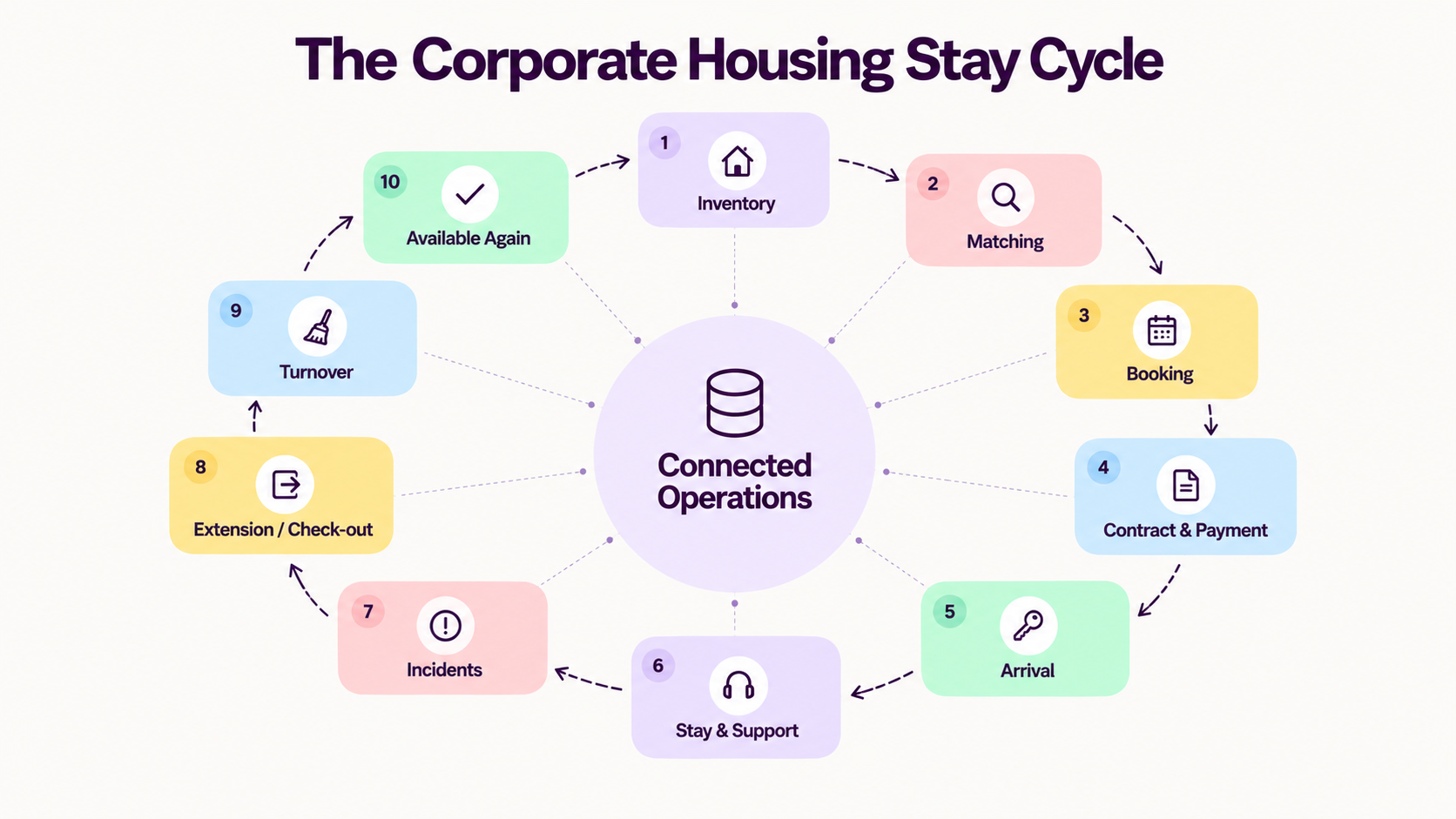
A corporate housing booking connects more than a resident to an apartment. It commits to dates, availability, contractual terms, payment responsibilities, and an arrival plan. The stay then creates maintenance requests, communication, potential extensions, and a departure that affects the next booking.
When those records sit in separate calendars, inboxes, and spreadsheets, teams must reconstruct the operation before making decisions. A departure change may reach the booking team without reaching housekeeping. A repair may be completed without the unit's readiness status being updated.
This article explains how to organize corporate housing operations as a connected stay cycle, from reliable inventory through resident experience and turnover, and how Floweal Management helps centralize that operation.
What are corporate housing operations?
Corporate housing operations are the processes used to prepare, allocate, and manage furnished accommodation throughout a temporary stay. They connect inventory, bookings, contracts, payments, maintenance, resident communication, and turnover. The scope depends on the operator's business model, service commitments, and local requirements.
The Corporate Housing Providers Association describes corporate housing as professionally managed, furnished temporary residential accommodation, typically for stays longer than 30 days. The operating principle is continuity: the same stay should be traceable from request to departure, while the property's condition and availability remain accurate for future demand.
Reliable inventory starts with property quality and readiness
Corporate housing inventory management combines property information, capacity, availability, and readiness. A unit should be offered for specific dates only when its conditions and operational status support that stay. Operators need a clear process for confirming changes, including repairs, turnover, and existing commitments, before availability is communicated to a client.
The inventory record should distinguish an entire apartment, a room, and a bed if the operator uses more than one allocation model. Capacity must use a consistent unit of measurement to avoid counting the same space twice. Photos, furnishings, included services, access arrangements, and restrictions should reflect the accommodation being offered. Reliable housing information supports decisions before booking and gives teams a reference when checking the arrival experience.
-
Physical readiness and commercial availability are different
A property may be unoccupied but unavailable because it requires inspection or repair. It may be ready to use but already committed to another stay. These conditions should remain distinct in the inventory record. An adaptable status model might separate ready, reserved, occupied, under preparation, and unavailable. Each label needs a definition and an owner. Marking a unit ready should reflect the operator's checks, not simply the previous resident's departure.
From matching a request to confirming a booking
A corporate housing booking workflow relates a client's needs to suitable inventory, then records the decision and agreed conditions. Digital tools can support matching by keeping inventory, dates, requirements, and booking status connected throughout the process.
Institutional requests may involve the organization paying, the person staying, and another team coordinating the move. These roles should be recorded rather than combined into a single contact whose responsibility is unclear.
The proposal should identify what is included and which conditions remain subject to confirmation. Matching can be performed manually or supported digitally; it should not be assumed to be automatic merely because a platform manages inventory.
A practical booking sequence
- Capture the request: destination, dates, occupants, relevant needs, and the client's approval process.
- Check inventory: date-specific availability, readiness, and conditions.
- Prepare options: accommodation details and proposed terms.
- Record the decision: chosen unit, approvals, and outstanding conditions.
- Confirm the commitment: evidence required by the operator's booking policy.
- Prepare delivery: contractual, financial, and arrival actions within the agreed scope.
Clear handoffs between these stages become especially important as requests increase across institutions and destinations.
Connecting digital contracts, payments, and deposits
Contracts, payments, and deposits should remain linked to the booking they support. Operators need to distinguish agreed charges, invoices, money received, amounts outstanding, and deposits requiring review. Digital records help maintain that relationship, but signature requirements, deposit treatment, and payment responsibilities depend on local rules and the agreements involved.
A signed agreement and a paid invoice are different milestones. Likewise, an amount requested is not necessarily an amount collected. Separating those states helps the team see which action is pending and who must resolve it. Digital contracts should reflect the correct unit, parties, dates, and version of agreed terms. A later extension or change needs an appropriate recorded amendment or agreement; updating a calendar alone does not update the contract.
-
Deposits require their context
The deposit record should identify the purpose, relevant agreement, payer, and status of any reconciliation or return. It should not be treated as rental revenue merely because cash has been received. At departure, decisions concerning deductions or refunds require evidence and appropriate review under the applicable contract and requirements.
Arrival and resident support are part of the operation
Resident experience management connects what was promised before booking with what is delivered during the stay. It includes arrival information, access, contact channels, and follow-up when something changes. The resident, institutional client, and local partners require the information relevant to their roles without relying on repeated explanations across disconnected conversations.
Before arrival, confirm access instructions, agreed dates, included services, and the support contact. If the arrival changes, check its effect on access and scheduled services instead of only replacing a date in the booking record.
Support after booking illustrates the same continuity principle in academic mobility: a confirmation starts a delivery obligation within the agreed scope; it does not end the operational process.
-
Communication needs an owner and a next step
An unresolved message should be linked to the stay, the issue, and a responsible person. Teams need to distinguish an acknowledgement from a solution, and an internal plan from information already communicated to the resident.
Clear escalation arrangements help residents know where to seek assistance. They also give the institutional client visibility into issues relevant to its responsibilities, without exposing unnecessary personal information.
Maintenance, incidents, and exceptions need shared context
Maintenance and incident management should connect the unit, affected stay, responsible actor, and next action. A repair can influence resident support, costs, and future availability. The operator needs to assess those dependencies and confirm readiness after resolution, rather than treating a closed maintenance task as proof that every related issue is settled.
Teams should define how time-critical issues are escalated, how access is coordinated, and how evidence is recorded. Repair responsibility and cost allocation depend on contracts and circumstances, not a universal rule that assigns every expense to the owner or resident.
-
Hypothetical example: a repair affects the next arrival
A resident reports a fault that requires work near the planned departure. The team records the issue, assigns a repair partner, and evaluates whether the unit can meet the next arrival commitment.
The booking team reviews alternatives if readiness is uncertain. Resident support communicates the relevant plan. The financial team reviews costs or adjustments under the agreement. Once the work is completed, the unit's operational status is checked before future availability is confirmed.
Fragmented property operations make such dependencies harder to identify when each team maintains its version of the case.
Extensions and departures change the inventory picture
An extension request changes the proposed stay period, but it does not automatically change the confirmed booking. The operator must check future availability, relevant agreements, and financial conditions before accepting it. Departure then requires review of the unit, unresolved issues, and turnover work before the accommodation is released for another stay.
If a later booking already exists, the team should not assume that a resident can be moved. Any alternative requires its assessment and agreement. The extension remains a request until the applicable decisions are completed. Checkout and readiness are also distinct events. The resident leaving does not confirm that inspection, cleaning, repairs, or deposit review are finished.
-
Hypothetical example: a requested extension overlaps a future booking
A corporate client asks to extend a stay while a university has a confirmed reservation for the same unit. The team checks both commitments and reviews whether an alternative is suitable and acceptable to the affected parties. If the extension is approved, its dates, contractual evidence, payments, and arrival planning for the next stay must remain consistent. If it is declined, the record should preserve the decision and communicate the existing departure arrangement.
Operational metrics and profitability need consistent definitions
Corporate housing metrics should explain both delivery and financial performance. Occupancy, unavailable days, incident resolution, operating expenses, and outstanding payments answer different questions. Each indicator needs a defined period and denominator. High occupancy alone does not demonstrate profitability, so each metric needs to be interpreted alongside the portfolio's operating and financial context.
- Occupancy: occupied unit-days divided by the inventory base defined for the period. Explain whether unavailable units are excluded, and report their downtime separately.
- Downtime: days units remain unavailable, separated by turnover, maintenance, or other reasons.
- Incident resolution: elapsed time from the defined start to confirmed resolution; open cases should retaintheirn age and priority.
- Operating cost: costs allocated consistently to the unit or stay, including the categories relevant to the business model.
- Payment visibility: invoiced, collected, and outstanding amounts without combining deposits with rental income.
- Profitability: a defined revenue and cost view that accounts for the portfolio's contractual and operating structure.
Together, these metrics provide a clearer view of how availability, stays, maintenance, and financial performance interact.
Connecting inventory with institutional demand
Institutional demand connects accommodation to universities, companies ,and relocation teams coordinating multiple stays. Operators require visibility into destination, dates, capacity, approval requirements, and service expectations. Forecast demand, qualified requests, and confirmed bookings must remain distinct, so planning decisions do not treat an expression of interest as a contractual commitment.
Academic programs may involve cohort-based calendars; companies may request accommodation around projects or employee moves. Understanding these demand patterns helps operators plan capacity while keeping forecasts, requests, and confirmed bookings clearly differentiated.
Operators adapting to international property demand should review which requests become bookings, why others do not proceed, and how stay extensions affect capacity. The purpose of demand analysis is to align inventory and delivery with evidenced needs.
How we connect corporate housing operations with Floweal Management
With Floweal Management, we centralize accommodation inventory and operations, connecting calendars, bookings, digital contracts, financial flows, and the day-to-day management of each stay. Within the Floweal ecosystem, Management connects the supply side with institutional demand coordinated through Desk and the resident experience supported through Go.
This connection gives housing operators a shared operational view of properties and stays while linking their inventory with universities, companies, and mobility programs.
Frequently asked questions
-
What does corporate housing inventory management include? It includes unit details, capacity, date-specific availability, condition, and readiness. The inventory should distinguish a vacant unit from one ready to accept a booking. Property records remain connected to stays and operational tasks, so maintenance, extensions, and checkout changes can be evaluated before availability is communicated.
-
What is the difference between property data and stay data? Property data describes the accommodation and its operating conditions. A stake data description includes a particular resident, booking, dates, and agreements. Linking them preserves context without allowing one reservation to overwrite the property record. Tasks such as inspections and repairs may affect both and need clearly assigned responsibility.
-
Why should payments and contracts remain linked to bookings? A booking establishes the context for contractual and financial obligations. Linking records helps distinguish signed terms, invoices, payments received, and amounts requiring action. An extension can impact all of them. Local requirements and agreements determine the appropriate review; a calendar update alone does not amend a contract.
-
How does Floweal Management connect to institutional demand? Floweal Management connects accommodation operations with the demand side of the Floweal ecosystem, including mobility programs coordinated through Desk. This allows operators to connect inventory and bookings with universities, companies, and mobility organizations within a shared operational flow.
We make it flow.
Explore this topic