International Property Management: When Local Operations Go Global
Learn how to effectively transition local property management to meet international demands with operational readiness and connected systems.


Having available inventory is not the same as being ready for international demand.
Universities, corporate housing providers, and mobility partners introduce different requirements, timelines, and expectations that local property operations were not designed to handle. When a university in Madrid needs 40 units in Lisbon for a semester cohort, or a mobility agency requires 15 furnished apartments across three European cities for relocating professionals, the operation must respond with accurate inventory, repeatable processes, and the ability to distribute availability across institutional channels without rebuilding workflows for every booking.
This is not about having more units. It is about operational readiness.
When Local Property Management Meets International Demand
International and institutional demand changes how property operations function. Local rental operations typically handle individual bookings through familiar channels with standardized local contracts and payment structures. International demand introduces cohort-based assignments, bulk booking requirements, extended mid-term leases, cross-border payment reconciliation, and compliance documentation that varies by destination market.
A property management system built to handle one city's rental operations does not automatically support an international mobility partner's workflow. The partner requires live inventory visibility, standardized property data across multiple markets, pricing disclosed in their currency, contract templates that accommodate institutional requirements, and a way to track assignment status without email coordination.
Available inventory must also be operationally ready. That means accurate availability calendars maintained in real time, property information structured consistently across markets, pricing that reflects actual rental terms without hidden fees, digital contracts that generate and execute without manual intervention, and reporting that provides visibility into occupancy and revenue across all distributed channels.
What Changes When Property Operations Cross Markets
Repeatable operations make new demand manageable. When a mobility partner sends a cohort of 30 relocating employees, the operation cannot rebuild the intake process, contract generation, move-in coordination, and payment reconciliation for that partner. The process must repeat consistently for every booking.
Institutional demand requires contracts that accommodate bulk assignments, invoicing that consolidates multiple units into partner-level billing, guest operations that handle cohort communication, and reporting that tracks performance across programs and destination markets. These are not features that exist in traditional property management software designed for individual unit-level rental operations.
International operations also introduce regulatory complexity that varies by jurisdiction. Lease terms, security deposit handling, occupancy documentation, and compliance requirements differ across markets. An operation serving international demand must structure these requirements into repeatable workflows rather than treating each market as a custom exception requiring manual coordination.
How Connected Operations Reduce Complexity Across Markets
Operational readiness opens new distribution channels. A structured operation can diversify beyond traditional marketplaces while maintaining visibility and control. Universities and corporate housing partners operate through institutional channels that require bulk inventory access, pricing transparency, and the ability to assign units directly without listing-level friction.
This requires property operations infrastructure that connects inventory management with partner distribution, contract execution, and guest services. When a mobility partner accesses inventory, they need to see accurate availability, assign units to participants, generate contracts, and track move-in status without switching between spreadsheets, email, and separate systems for each destination.
Connected operations also reduce internal coordination costs. When inventory, contracts, payments, and guest communication flow through one system rather than across fragmented tools, the operation scales without multiplying manual work. Teams managing international programs can handle higher volumes because the infrastructure executes repeatable processes rather than requiring custom coordination for every booking.
From Property Management to International Distribution
International property management is not about translating a local operation into multiple languages. It is about building operational infrastructure that connects distributed inventory with institutional demand across markets, compliance requirements, and partner workflows.
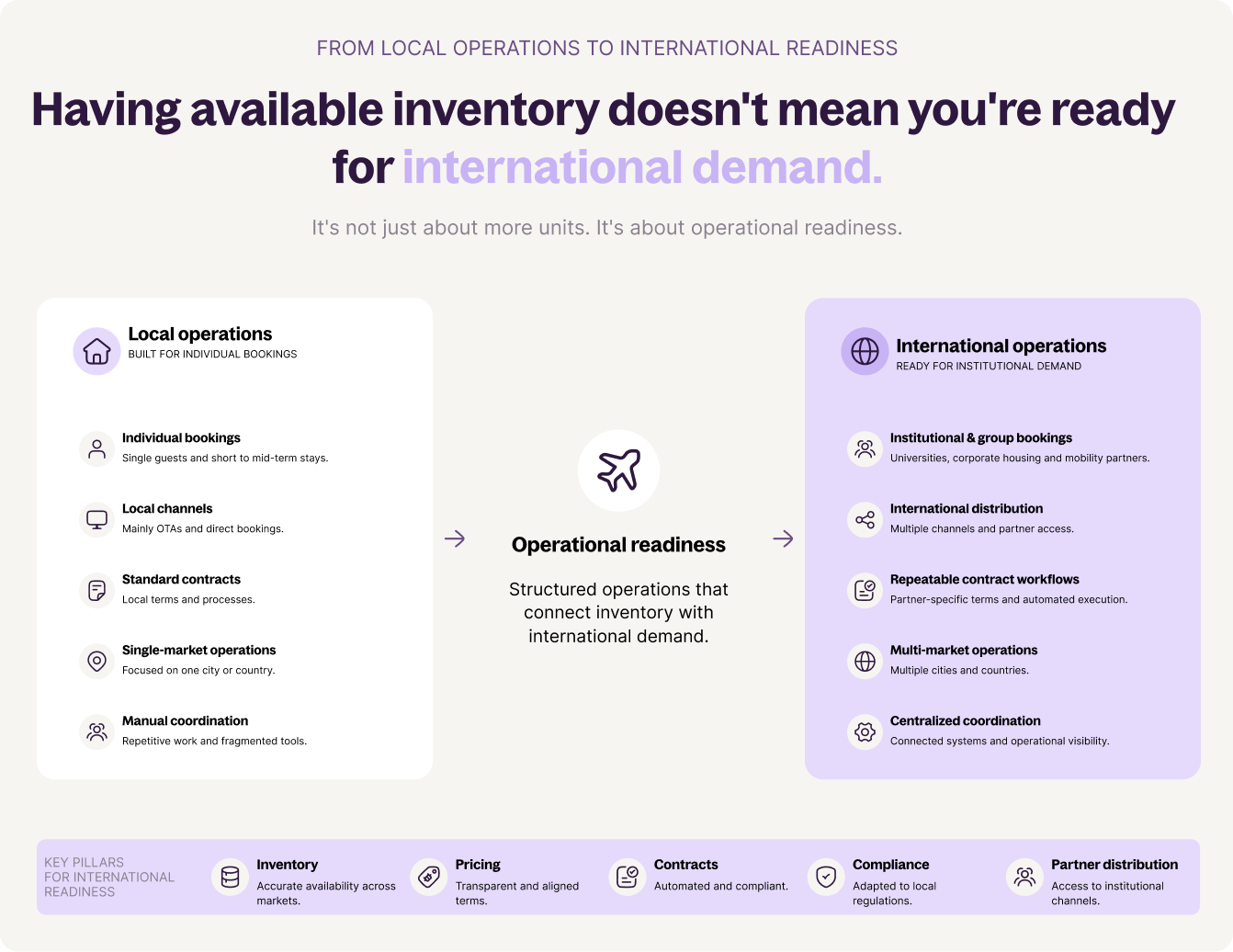
Floweal Management structures property operations for international distribution. It unifies inventory management, partner access, contract execution, and operational visibility in one connected system. Property owners and operators can distribute inventory to universities, corporate housing partners, and mobility agencies while maintaining centralized control over availability, pricing, and assignment status. Contracts generate automatically with partner-specific terms. Payments reconcile across bulk assignments. Guest operations coordinate move-ins across markets without rebuilding the process for every cohort.
This is operational readiness for international demand. Not more dashboards. Not manual coordination disguised as software. Infrastructure that connects property operations with the channels, partners, and markets that drive institutional demand.
Frequently Asked Questions
-
What is international property management? International property management is operational infrastructure that connects distributed accommodation inventory with institutional demand across markets, compliance requirements, and partner workflows. It goes beyond managing units in one city to structuring repeatable operations that serve universities, corporate housing partners, and mobility agencies across destination markets without multiplying manual coordination work.
-
How can property operators prepare for international demand? Property operators prepare for international demand by structuring accurate inventory visibility, standardized property data, repeatable contract execution, and partner distribution workflows. This means maintaining live availability calendars, pricing that reflects actual rental terms, digital contracts that accommodate institutional requirements, and reporting that provides visibility into occupancy across channels and markets.
-
How can owners diversify beyond traditional rental marketplaces? Owners diversify beyond traditional marketplaces by building operational readiness for institutional channels. Universities, corporate housing providers, and mobility partners require bulk inventory access, pricing transparency, repeatable contract workflows, and the ability to assign units directly. Connected operations infrastructure enables property owners to serve these channels while maintaining centralized control over inventory, pricing, and assignment status across markets.
We make it flow.
Explore this topic