How to Prevent Double Bookings When Managing Multiple Rental Channels
Learn how to eliminate double bookings across rental channels with effective inventory management, verified connections, and clear booking rules.


One channel confirms an apartment while another still displays the same dates as available. A second reservation arrives before the calendars agree. Your team now has two commitments for accommodation; it can supply only once.
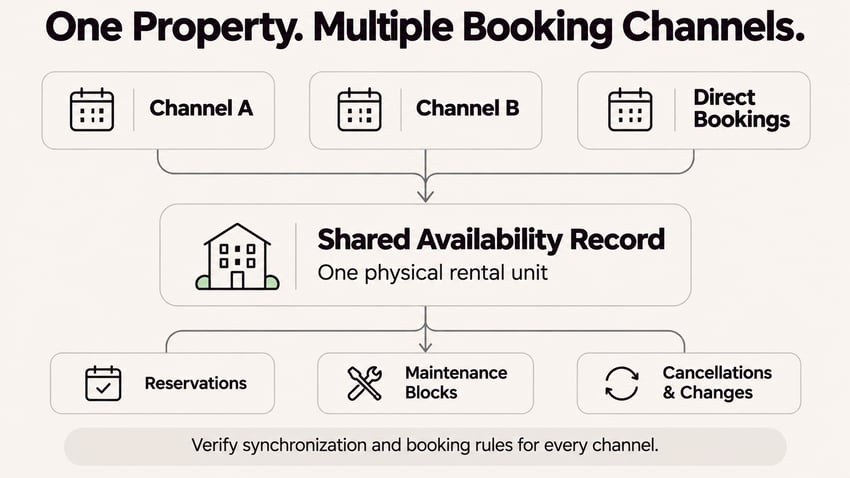
To reduce double bookings, identify the physical inventory behind every listing, define which booking states consume it, verify each connection’s behavior, and capture reservations from every source. A rental channel manager supports that process, but connectivity does not replace inventory rules or exception ownership.
Why Double Bookings Happen Across Rental Channels
A double booking occurs when confirmed commitments exceed compatible physical capacity for overlapping dates. Causes include stale availability, incorrect listing mappings, unrecorded direct reservations, inconsistent status rules, and changes that do not reach every sales channel.
Duplicate records are different: two imported records may represent one reservation. Compare booking references before treating duplication as a second guest commitment. A booking conflict can also involve maintenance or an owner block, even without two reservations.
Define One Inventory Record for Each Rentable Unit
Give every physical unit a stable identifier and map each external listing to it. Distinguish apartments, rooms, and beds rather than counting each advertisement as additional inventory.
If an apartment can be sold whole or room by room, define the shared-capacity dependency: a whole-apartment booking must make its rooms unavailable; a room booking must prevent an overlapping whole-apartment sale. Confirm whether your systems enforce this relationship. Where they cannot, restrict simultaneous distribution or introduce a controlled manual process.
Establish a Source of Truth for Availability
Designate the authoritative record used to reconcile reservations, blocks, cancellations, and extensions. Bookings may originate externally, but each must reach that record through a verified connection or assigned manual workflow.
Define who may change dates or release inventory. Record owner stays, maintenance closures, and preparation periods alongside commercial commitments. An empty unit is not necessarily sellable. Our corporate housing operations guide explains the distinction between readiness and availability.
Verify What Each Channel Connection Actually Synchronizes
Document the scope of every connection instead of assuming all channels exchange the same information. For each, record direction, supported fields, booking states, update mechanism, failure reporting, and the person responsible for reconciliation.
| Connection approach | What to verify | Risk to control |
|---|---|---|
| API integration | Supported actions, fields, delivery, acknowledgments, and failure handling. | Unsupported restrictions, rejected updates, interruptions, or simultaneous acceptance. |
| Calendar feed | Import/export direction, refresh behavior, event interpretation, and date boundaries. | Stale dates and information not represented in the feed. |
| Manual workflow | Entry ownership, coverage hours, blocking, and verification. | Unrecorded commitments and delayed updates. |
Align Booking Statuses and Inventory Rules
Define explicitly when each booking state consumes capacity. An inquiry need not block inventory; a temporary hold may block until expiry; a confirmed reservation consumes the agreed capacity. Payment and approval milestones should follow your commercial policy, not assumptions inferred from a calendar label.
Check minimum stays, permitted arrival days, occupancy limits, timezone conventions, and turnaround requirements. Define checkout boundaries: if departure is excluded, a September 1–10 stay occupies nights September 1–9. Same-day resale still depends on preparation and access arrangements.
Release dates after a cancellation only when the cancellation is validated and other commitments or blocks have been checked. Reopening one channel does not prove the change reached the others.
Record Bookings From Non-Connected Channels
Assign someone to enter direct, institutional, and offline commitments and verify affected availability before confirming them under your booking policy. Capture the physical unit, dates, capacity, status, external reference, and responsible contact.
A university allocation may cover several rooms rather than one apartment. Record its actual scope. When an extension arrives, check the additional dates before approval; an existing resident does not automatically have priority over a later commitment. Provide backup coverage when the usual coordinator is unavailable.
Test Changes, Cancellations, and Exceptions
Test the complete reservation lifecycle before adding distribution and after relevant configuration changes. Use a controlled test environment or an agreed test procedure that avoids unintended live commitments.
- Create a booking and verify affected inventory across channels.
- Change dates, unit, and occupancy; check both released and newly consumed capacity.
- Cancel, expire a hold, and add a maintenance block.
- Test whole-unit and room-level dependencies.
- Check interrupted connections, recovery, and duplicate-message handling where supported.
Keep expected results, observed results, and unresolved exceptions. A successful initial import does not establish that amendments or cancellations behave correctly.
Monitor Conflicts and Define an Escalation Process
Assign an owner to review unresolved updates, conflicting dates, and differences between central and channel records. Use available monitoring tools and scheduled reconciliation; do not assume overlap alerts exist in every system.
When capacity is uncertain, assess whether affected sales should be paused or restricted and verify that action channel by channel. Preserve references, timestamps, status changes, and communications. Review contractual obligations and channel procedures before cancellation, relocation, or compensation.
An earlier timestamp helps reconstruct events; it does not establish a universal priority rule. Give affected parties realistic updates, identify an authorized decision-maker, and confirm resolution in every relevant record. Broader coordination gaps make ownership particularly important.
How Floweal Management Supports Multi-Channel Operations
With Floweal Management, we centralize bookings, availability, and portfolio operations. Channel Hub includes publication through Go and Desk, connected distribution channels, manual registration of bookings from non-connected channels, and an API for marketplaces.
These capabilities connect multi-channel rental inventory with a shared operational record. Our Pro plan adds incident management, alerts, financial tools, and check-in/check-out operations. Enterprise includes Pro functionality and custom integrations. Verify the relevant plan and integration scope for your operation.
We do not equate a connected calendar with guaranteed instant synchronization, automatic conflict resolution, or universal channel coverage. Parent-child inventory enforcement and specific monitoring behavior should be confirmed before relying on them.
Frequently Asked Questions
-
Can a rental channel manager eliminate double bookings? No system should be assumed to eliminate every conflict. Connection behavior, mapping, booking rules, and manual work all affect exposure. Evaluate the controls and exception process rather than treating centralized availability as a guarantee.
-
Is an API connection always faster than a calendar feed? Not as a universal rule. Compare the actual implementation, delivery mechanism, refresh behavior, and failure handling. Neither the API label nor the calendar format establishes a guaranteed end-to-end update time.
-
Should inquiries block availability? Only under a defined policy. Distinguish an inquiry from a temporary hold and confirmed booking. If it holds consume capacity, specify expiry, release ownership, and how that state is represented across channels.
-
What should happen after a cancellation? Validate the cancellation, check other commitments and operational blocks, update the authoritative record, and verify channel availability. Avoid reopening dates automatically through a manual shortcut that bypasses the agreed checks.
-
What should teams do when two bookings overlap? Verify physical capacity and references, control affected sales where appropriate, preserve evidence, and escalate to an authorized owner. Follow applicable agreements and channel procedures; confirmation order alone does not resolve contractual responsibilities.
Operational Checklist Before Expanding Distribution
- Map listings to physical capacity and dependencies.
- Define booking states, dates, and release authority.
- Verify connection scope and manual-entry coverage.
- Test changes and reconcile exceptions.
- Assign conflict ownership and communication responsibilities.
Expand distribution with evidence that inventory rules and handoffs work together. Explore Floweal Management for connected portfolio operations while retaining clear controls for each channel.
We make it flow.
Explore this topic