Optimizing Multi-Property Incident Management for Property Owners
Optimize incident management across multiple properties with effective strategies and software to enhance communication, tracking, and resolution.


Receiving an incident report is not the same as managing the incident. An email describes the problem, a message adds a photo, and a partner calls to confirm a repair. Unless those updates connect to one case, the team may still be unable to tell what is resolved and what needs attention.
Each incident requires context, a person responsible for coordination, a next action, and clear closure criteria. Without those connections, managing multiple properties depends on remembering conversations and repeatedly asking for updates.
This guide explains how to organize incident follow-up across rental properties and co-living spaces, maintaining a portfolio-wide view without losing the detail of each case.
Key Principles for Incident Follow-Up
- Turn reports into actionable records. Connect the issue to its location, impact, responsible person, and next step.
- Separate responsibilities. Coordination, technical work, and authorization are different roles, even when one person performs more than one.
- Make statuses meaningful. A status should explain what is happening, what is pending, and who acts next.
- Verify before closing. Record the outcome, communicate it to the resident, and retain enough history to continue or reopen the case.
How to Manage Incidents Across Multiple Properties
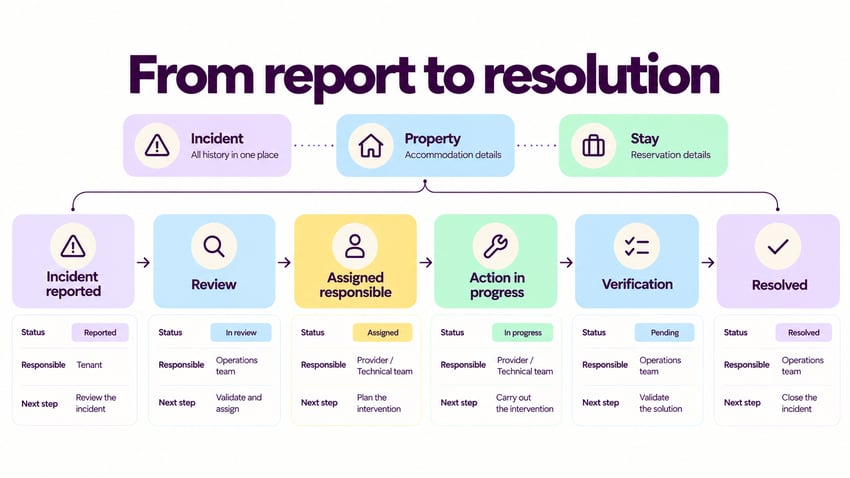
Start by logging the report, assessing its impact, assigning responsibility, and defining the next action. Keep the case updated through review, intervention, verification, and communication of the outcome.
Urgent situations need a separate response and escalation procedure appropriate to the issue. Routine tracking should not delay action when immediate assistance is required. An inbox shows messages. It does not necessarily show whether a visit is confirmed, an authorization is pending, or a completed repair still needs verification. The incident record must make those distinctions visible.
Work can be underway without the wider team understanding its status. A shared record preserves continuity so another team member can identify what has happened and what remains unresolved.
What an Incident Report Should Include
A useful report gives the team enough information to begin a review. Residents should not need to diagnose the technical cause or provide information unrelated to the case. Include:
- Location: the property, unit, room, item, or common area affected.
- Stay context: the associated stay and affected people, where relevant.
- Description: what has been observed and how it affects use of the accommodation.
- Timing: when the issue was detected and reported.
- Supporting evidence: relevant images or details, only when they can be obtained safely.
- Contact details: the information needed to coordinate follow-up.
- Management details: the person responsible, current status, and next action.
If several people report the same issue through different channels, link those reports to one case while preserving relevant details. A preferred reporting channel can simplify intake, but the process must also accommodate necessary phone calls and other reports.
Separate Coordination, Execution, and Approval
The person coordinating a case may not carry out the repair or authorize the work. Each role should be clear:
-
Coordination: maintains the record, follows up, and communicates progress.
-
Technical execution: assesses the issue and performs the agreed intervention.
-
Authorization: approves work or other decisions where required by the applicable agreement.
Assigning a technical partner does not remove the need for coordination. The case still needs someone to track dependencies, confirm the next step, and arrange verification.
Keep a History Another Team Member Can Use
The case history should record reports, actions, status changes, decisions, responsibilities, and relevant communications. Its purpose is continuity, not a transcript of every conversation.
After a visit, record what was inspected, what work was completed, and what remains pending. Relevant updates received by phone should also be added to the case. Dates, evidence, and decision context allow another person to continue the follow-up without starting again. They also help the team recognize recurring issues linked to a property, unit, or room.
Make Statuses Explain the Next Action
A flexible status model might include “Received,” “Under Review,” “Assigned,” “In Progress,” “Blocked,” “Pending Verification,” and “Closed.” The labels matter less than their definitions.
“In Progress” should not conceal an unconfirmed appointment or a wait for authorization. A blocked case should identify the dependency, who must resolve it, and when it will be reviewed again. Keep reported completion separate from verified resolution. A partner may have finished the work while the team still needs to check the outcome and its effect on the stay or unit readiness.
What a Portfolio View Needs to Show
Teams managing multiple units have to identify where action is required without reconstructing every case from messages. A useful portfolio view highlights:
- New reports awaiting review or assignment.
- Assigned actions that still need confirmation.
- Blocked cases, their causes, and the next responsible person.
- Visits or inspections awaiting a confirmed date.
- Repairs reported as complete but pending verification.
- Incidents that may affect a current stay or future arrival.
- Units whose availability requires reassessment.
Build that view from the same individual case records. A separate spreadsheet can create another version of the situation and introduce further reconciliation work.
Communicate Progress Clearly to Residents
Each update should distinguish what is known, what has been done, and what remains pending. Confirmed appointments should be described as confirmed; proposed dates should remain clearly provisional. When progress depends on access, authorization, or a partner, explain that dependency and state when the next update will be provided.
For example: “We have logged the issue and requested a site visit. Access is still awaiting confirmation. We will update you tomorrow, even if the appointment has not yet been confirmed.”
This message describes an action without presenting it as a completed outcome. It also gives the resident a clear follow-up point. Support during a stay requires continuity. If there is no new development, keep the agreed update rather than leaving the resident to ask again.
Verify the Outcome Before Closing the Case
Closure should follow criteria appropriate to the incident. Record what was checked, who verified it, and whether any related action remains outstanding. A repair may resolve the technical issue without resolving its effect on unit readiness or a future arrival. Review those dependencies separately and communicate the relevant outcome to the resident.
If the problem persists, keep the case open or reopen it with the previous history intact. That context helps the next review build on the work already completed.
Centralize Property Operations With Floweal Management
For teams managing rental properties and co-living spaces, Floweal Management centralizes accommodation operations within the wider Floweal international mobility platform.
We connect property and stay context so teams can coordinate daily operations without treating each update as an isolated conversation. Incident follow-up should remain linked to the affected unit, stay, and relevant responsibilities, with clear next actions and verification criteria. Discover Floweal Management to explore how a connected operational flow can support coordination across your properties.
Frequently Asked Questions
-
What Is the Difference Between Receiving a Report and Managing an Incident? Receiving a report means learning about the issue. Managing it means reviewing its context and impact, assigning responsibilities, tracking action, verifying the outcome, and communicating the resolution. Forwarding a message to a technical partner may be one step, but it does not complete the process.
-
How Many Statuses Does Incident Tracking Need? There is no mandatory number. Use enough statuses to distinguish review, assignment, active work, dependencies, verification, and closure. Each status should make responsibility and the next action clear rather than simply adding another label.
-
What If the Repair Is Complete but the Problem Persists? The case needs further review and a new action. Keep it open or reopen it while preserving earlier reports, work performed, and verification results. Reported completion should not be treated as proof that the issue is resolved.
-
Does Every Incident Affect Future Reservations? No. Assess the specific effect on safety, usability, and readiness. An incident may affect the current stay, a future arrival, or neither. Review its relationship with the unit’s calendar before changing or confirming availability.
Keep the Case Connected From Report to Resolution
Effective incident management depends on shared context, defined responsibilities, visible next actions, and verified outcomes. A portfolio overview is useful only when the team can trace it back to the individual case.
The operational standard is clear: another team member should be able to understand the situation and continue the follow-up without reconstructing the conversation.
We make it flow.
Explore this topic