Estimating Housing Demand for Academic Mobility: A Comprehensive Guide
Learn how to forecast housing demand accurately for academic mobility programs by analyzing historical data and participant needs for effective planning.


Housing planning cannot always wait until registration closes. While participants are still confirming their places, accommodation partners need an indication of the capacity the institution may require. Waiting for final numbers can narrow the available options and leave less time to negotiate terms.
A practical forecast gives the team a starting point, not a reservation commitment. It estimates housing needs by cohort, destination, and date, compares them with confirmed usable capacity, and changes as enrollment and requirements become clearer.
What housing demand forecasting means for academic mobility?
Housing demand forecasting estimates how many participants will need institutionally arranged accommodation, where they will stay, and when they will need it. The forecast should distinguish between:
- Expected program participants.
- Confirmed participants.
- Participants expected to need institutionally arranged housing.
- Confirmed housing requests.
- Participants with assigned accommodation.
- Requests still awaiting confirmed accommodation.
These figures answer different questions. Total enrollment does not equal housing demand because some participants arrange their accommodation. Likewise, a projected requirement is not the same as a confirmed request or an assigned bed.
Step 1. Review comparable participant and housing data
Start with previous programs and destinations. Review participant numbers, housing requests, self-arranged accommodation, arrival and departure dates, stay lengths, room types, cancellations, and subsequent changes. Compare earlier forecasts with the housing actually required.
In a hypothetical example, one program period had 80 participants and 60 institutional housing requests. Another had 100 participants and 75 requests. Both recorded a 75% request rate. That rate may provide a starting assumption, but only if the programs remain comparable.
Changes in destinations, housing policies, program design, or cohort characteristics can make a historical rate less useful. Document those differences rather than carrying the percentage forward unchanged. Record each data source, extraction date, and validation owner. Preserve dated forecast versions so the team can compare expectations with results without rewriting the original assumptions. Where information is missing, identify the uncertainty before sharing a provisional estimate as though it were a firm commitment.
Step 2. Break demand down by destination and stay dates
A semester-wide total is not enough to plan capacity. Segment requirements by country, city, campus, program, cohort, arrival date, departure date, and accommodation type. Include relevant requirements, such as accessibility, while collecting only the information needed for planning.
Two cohorts of 40 participants may need very different arrangements. They might arrive in different cities, overlap for part of the semester, or use the same capacity in sequence. Keep two measures separate:
- Beds: capacity to accommodate people at the same time.
- Bed-nights: the total volume of overnight accommodation. Ten people staying for 30 nights require 300 bed-nights.
Bed-nights help describe the overall requirement, but they do not reveal peak simultaneous demand. That requires a date-by-date view of overlapping stays.
Step 3. Calculate the initial housing forecast
Use a simple starting calculation: Projected participants needing institutional housing = estimated participants × expected institutional housing request rate.
Base the rate on comparable historical requests and adjust it for documented changes. In a hypothetical cohort of 120 participants with a 75% expected request rate, the estimate is 90 participants requiring accommodation. It is not a confirmation of 90 reservations.
Next, distribute those expected stays across arrival and departure dates. If all 90 participants require housing on the same night, the simultaneous requirement is 90 beds. If stays do not overlap, peak demand may be lower. Account for preparation time between stays when it prevents a bed from being reassigned immediately. Capacity is only reusable when dates, turnaround requirements, and accommodation needs allow it.
Step 4. Build low, base, and high-demand scenarios
A single figure can hide uncertainty. Build scenarios that show how requirements could change as registrations, confirmations, cancellations, destinations, and stay lengths develop. For each scenario, record:
- The expected participant count.
- The assumed share needing institutional housing.
- Arrival and departure patterns.
- Known changes or uncertainties.
- The resulting demand by destination and date.
Change assumptions deliberately. If the purpose is to test the housing request rate, keep participant numbers and dates consistent across scenarios. If several inputs change, make each change visible so the team can understand what drives the result.
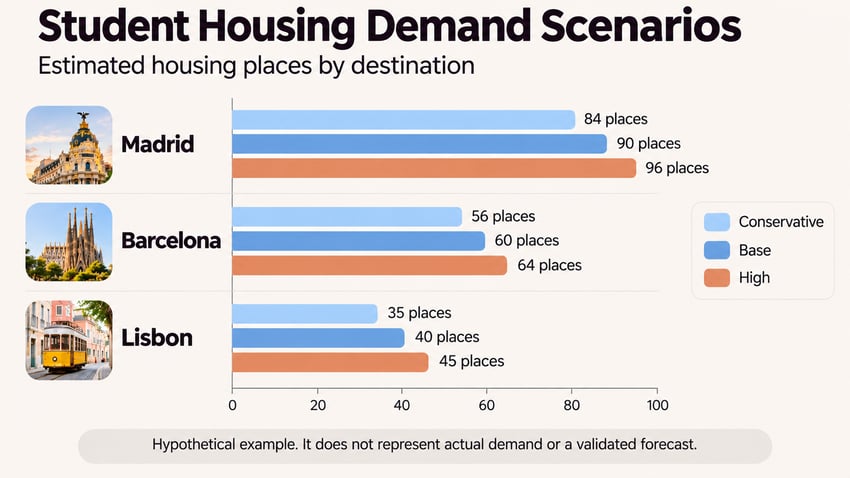
These scenarios are planning assumptions, not validated statistical predictions or measures of total market demand. Apply a consistent rounding method when converting fractional estimates into whole-bed requirements, and state where rounding occurs.
Step 5. Compare demand with confirmed usable capacity
Published inventory is not the same as accommodation secured for a program. Define capacity statuses clearly:
- Advertised: listed supply without a verified commitment for the required stay.
- Confirmed: availability agreed for specified dates and conditions.
- Held or reserved: capacity whose commitment, expiry date, release rules, and financial terms must be checked.
- Pending: capacity still awaiting confirmation and excluded from confirmed totals.
A bed may appear in more than one record or status. Use identifiable capacity records and consistent counting rules to avoid duplication. Also distinguish capacity already allocated to the cohort from capacity still available for assignment.
Capacity gap = projected simultaneous demand − confirmed usable capacity for the same destination and dates.
Usable capacity must meet the required stay dates, occupancy conditions, and relevant accommodation requirements. In a hypothetical planning window with demand for 90 beds and 82 usable beds, the shortfall is eight. A negative gap indicates a capacity margin in that window. It does not mean those beds can automatically cover another destination, a different date range, or an incompatible requirement.
Step 6. Plan flexibility without assuming unlimited availability
Prepare responses to late registrations, cancellations, delayed arrivals, and changes in destination or requirements. The response might involve negotiating an extension, securing a time-limited option, or identifying a compatible alternative. The commitment matters. A firm reservation creates obligations under its terms. A temporary hold may expire. Uncommitted availability may disappear before the institution is ready to book.
There is no universal buffer percentage or requirement to reserve extra inventory. Choose the margin and contractual flexibility according to the program’s uncertainty, budget, and risk tolerance. Review release deadlines, cancellation charges, and approval responsibilities before committing funds or capacity.
Step 7. Set a review schedule and assign ownership
The forecast should change when the underlying information changes. Set review points around the academic calendar and accommodation commitments rather than relying on an arbitrary update frequency.
| Planning stage |
Information to review | Operational decision |
|---|---|---|
| Initial planning | Historical demand, planned programs, and destinations | Establish the first forecast and its assumptions. |
| Registration period | Confirmations, housing requests, and withdrawals | Update scenarios and expected demand. |
| Capacity review | Usable capacity, requirements, and contractual deadlines | Address gaps and confirm assignments progressively. |
| Before arrivals | Final stay dates, assignments, and unresolved requests | Validate coverage and assign outstanding actions. |
| Latest changes | Additions, cancellations, delays, and revised dates | Recalculate demand and communicate affected decisions. |
Assign an owner, data cutoff, and version date to each forecast. Preserve the earlier versions while making clear which one the team should use for current decisions.
Metrics that show whether the forecast is useful
Measure accuracy and operational coverage separately. A forecast can be numerically close to actual demand while still missing a shortage in one destination or arrival window.
- Absolute percentage error: absolute difference between forecast and actual demand, divided by actual demand, multiplied by 100. Use only when actual demand exceeds zero. If actual demand is zero, report the absolute difference in beds instead.
- Forecast variance by planning window: compare projected and actual requirements for equivalent destinations and dates. Keep the direction of the variance visible and sum absolute differences when measuring total error, so surpluses do not cancel out shortages.
- Uncovered housing demand: confirmed requirements without confirmed suitable accommodation. This identifies outstanding actions, rather than forecast accuracy alone.
- Confirmed usable capacity: beds secured by destination and date, not the total inventory advertised.
- Assignment coverage: participants with confirmed suitable assignments divided by participants requiring institutional housing, multiplied by 100.
- Changes since the baseline: additions, withdrawals, and date or requirement changes recorded after the initial forecast.
- Confirmation lead time: days between accommodation confirmation and arrival, showing how much time remains for preparation.
Use consistent definitions and compare equivalent periods. Percentage indicators with a zero denominator should be reported as not applicable. There is no universal performance benchmark that fits every program.
Connect housing coordination with Floweal Desk
Forecasting becomes harder when participant records, dates, housing requests, and assignments sit in separate files and conversations. Teams need shared operational information to understand what has changed and which decisions remain open.
With Floweal Desk, we connect programs, participants, destinations, documentation, and accommodation coordination. That shared context supports the review of requests, assignments, and changes across the program.
The forecasting method remains the institution’s responsibility. Floweal Desk should not be assumed to calculate enrollment probabilities, generate demand forecasts, block inventory automatically, produce predictive budgets, or guarantee accommodation availability. Its role here is to support coordination around the information and decisions the team manages.
Frequently Asked Questions
-
How do you estimate housing demand for international students? Multiply expected participation by the estimated share requiring institutionally arranged housing. Then distribute those stays by destination and date to calculate simultaneous demand. Keep forecasts separate from confirmed requests and reservations.
-
What data does a university need to plan housing capacity? Comparable historical participation and housing requests, current registrations and confirmations, destinations, arrival and departure dates, accommodation requirements, cancellations, and confirmed usable capacity. Each figure should have a source and an update date.
-
How far in advance should university housing planning begin? Begin when the program’s destinations, dates, and expected participation are being defined. Update the forecast as registration develops and before contractual deadlines. There is no single lead time suitable for every program or destination.
-
How does stay length affect the number of beds required? Stay length determines bed-night volume, while overlapping dates determine simultaneous bed demand. Successive cohorts may reuse the same beds if their dates, preparation time, and accommodation requirements are compatible.
-
What should the team do when projected demand exceeds capacity? Verify the shortage for the specific dates and requirements, check the status of existing commitments, and assess compatible alternatives. Assign an owner to each unresolved gap and communicate any decisions requiring institutional approval.
-
How should the forecast change when enrollment changes? Record additions, withdrawals, and revised dates or requirements. Recalculate scenarios, simultaneous demand, and capacity gaps. Publish a dated update while preserving previous versions for comparison.
Keep each cohort’s housing plan current
A useful forecast turns incomplete information into explicit assumptions and actionable decisions. It does not remove uncertainty or replace accommodation commitments.
Keep participants, dates, requirements, and capacity aligned as the semester approaches. With clear ownership and a shared view of outstanding gaps, the institution can prepare each cohort’s housing arrangements before unresolved needs become arrival-day problems.
We make it flow.
Explore this topic