Mastering Digital Compliance for International Student Mobility
A guide to digital compliance for international students, which outlines requirements and processes to facilitate academic mobility.


Collecting every document does not mean a student mobility program is ready. Teams need to know which requirement each file supports, what has been received, what still needs review, and who is responsible for the next decision.
Across large cohorts and multiple destinations, that context can become fragmented across spreadsheets, emails, and departments. A file may be received but not reviewed. An earlier validation may no longer apply. A change in travel dates may reopen a requirement that appeared complete. This guide explains how to connect requirements, documents, statuses, and responsibilities in a digital tracking process that can be adapted to different international mobility programs.
What Is Digital Compliance in Student Mobility?
Digital compliance in student mobility is the use of digital processes to organize and track program requirements, supporting documents, review statuses, responsibilities, dates, and decisions. It supports coordination and traceability; it does not establish compliance on its own. Requirements depend on the institution, program, origin and destination countries, participant profile, nationality, and applicable regulations. The institution must determine which requirements apply and who is authorized to interpret and review them.
Digital tracking makes those decisions visible. A “validated” status should show what was reviewed, against which criteria, by whom, and within what scope.
Organization, Review, and Compliance Are Different
Organizing a document means placing it in the right context. Reviewing it means assessing it against defined criteria. Meeting a requirement depends on the applicable rules and the outcome of the relevant process. For example, receiving a permit does not confirm that its dates or conditions cover a particular mobility experience. That assessment belongs to the designated reviewer, not to the act of uploading the file.
Why Compliance Tracking Becomes More Complex as Programs Grow
The challenge is not simply more students or more documents. It is more about relationships to coordinate: destinations, participant profiles, deadlines, departments, and changing requirements.
One cohort may include exchanges, internships, and other mobility arrangements. Admissions, international relations, housing teams, insurance contacts, and immigration specialists may each manage a different part of the process on different timelines.
A scalable process preserves continuity between those teams. The operational question is how much work it takes to establish the status of a case and identify its next action.
-
Document Counts Do Not Show the Full Workload
Two programs with the same number of participants can require quite unfamiliar levels of coordination. Uniform requirements create one workload; multiple destinations, exceptions, and schedules create another.
Define which conditions affect each requirement and which changes trigger a new review. A destination change or an extended stay may alter the case even when the cohort size remains unchanged.
How to Organize International Student Documents
Link each document to the participant, the specific mobility experience, and the requirement it supports. Record its version, receipt date, review status, responsible person, and validity period where relevant.
These connections help teams distinguish a current reference from an outdated file or a submission still awaiting review.
Email can remain a communication channel, but it should not be the only record of a case. Define how emailed documents are added to, or referenced within, the institution’s authorized tracking environment.
-
Track Versions Without Treating the Latest File as Valid
The newest submission may be incomplete. An earlier version may still be relevant to a different period or decision.
Keep receipt, review, and validation distinct. The record should identify which version supports the current decision. Retain previous versions only where appropriate, label them as historical, and apply the institution’s retention policy.
-
Reduce Duplication Without Losing Program Context
A document may support more than one mobility experience, but its suitability must be assessed for each case.
Where appropriate, use a shared reference in an authorized repository rather than creating unnecessary copies. Keep requirements, review statuses, and decisions linked to each mobility experience. Validation for one program should not automatically carry over to another.
How to Digitize Document Tracking for Study Abroad
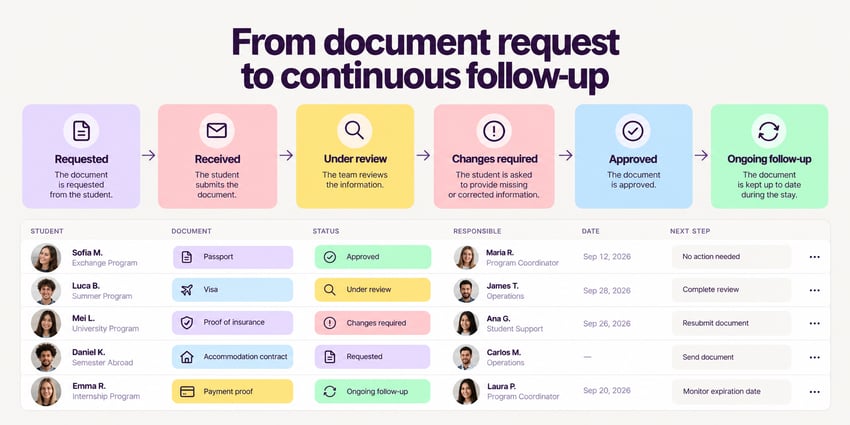
Start by identifying applicable requirements, connecting them to each participant, and defining the steps from request to closure. The following workflow provides a practical reference, not a substitute for institution-specific procedures.
1. Register the participant and the mobility experience
Distinguish the person from each program they join. A participant may complete several mobility experiences, each with its own requirements and history. Avoid duplicate records and collect only the information needed for the program.
2. Confirm the program, destination, and dates
Link the case to the relevant program, destination, scheduled period, and participating departments. Keep provisional information clearly marked so that unconfirmed dates or destinations are not treated as final.
3. Identify applicable requirements
The responsible department defines what is required, when it applies, and the basis for that determination. Use standard templates where helpful, then adapt them to the participant’s profile and circumstances.
4. Send clear submission instructions
Explain what to submit, where to submit it, whom to contact, and when it is due. Distinguish institutional deadlines from external deadlines and document validity periods. They serve different purposes and may have different consequences.
5. Record receipt against the correct requirement
Record the submission date and document reference, then connect the file to the appropriate case and requirement. “Received” means the information has arrived, not that it has been accepted or validated. Resolve missing context before relying on a file as evidence.
6. Assign and complete the review
The designated reviewer assesses the document within their area of responsibility and records the result. If another department or specialist must intervene, identify that responsibility and keep the next action visible.
7. Resolve corrections and exceptions
State exactly what is missing or needs correction. For an exception, record the reason, the responsible decision-maker, and its effect on the requirement. An informal note is not enough if the team cannot understand what was decided.
8. Record the decision and supporting evidence
Link the review outcome to the document version and criteria used. Record who made the decision and when. Distinguish an internal review from any decision issued by an external authority.
9. Monitoring changes during the program
Continue tracking relevant validity periods, housing changes, destination changes, and extensions of stay. Assess which requirements or actions each change affects rather than assuming every change follows the same procedure.
10. Close or update the mobility record
Separate completed actions from unresolved items handed over for follow-up. Apply retention rules to the documentation. When a participant starts another program, create or update the appropriate mobility record while preserving any previous context that must be retained.
Privacy and Data Protection
Document tracking must account for the information collected, who can access it, how it is stored and shared, and how long it is retained. Some files may contain sensitive or specially protected personal information.
The institution’s relevant departments should assess applicable obligations, processing purposes, responsibilities, and data transfers. Operational visibility does not require unrestricted document access: a team member may need to see a status without viewing the underlying file.
-
Define Access, Collection, and Storage Rules
Specify who can view, upload, review, or modify information. Remove access when it is no longer appropriate, and review storage security, transmission methods, shared links, and incident response procedures.
Where the GDPR applies, relevant principles include purpose limitation, data minimization, accuracy, and storage limitation. A participant’s nationality alone does not determine applicability or the legal basis for processing.
-
Assess Educational Records Requirements
Where FERPA or other educational records rules apply, the institution must assess access and processing under the relevant requirements. Digital centralization does not replace that assessment.
-
Set Retention and Closure Criteria
Define which records must be retained, for how long, and on what basis. Some operational evidence may need to remain while unnecessary copies are deleted according to policy and applicable obligations.
Access and change logs also require appropriate management. Traceability supports oversight; it does not justify indefinite retention or broad access to the full history.
Connecting Document Tracking With Floweal Desk
For institutions managing international mobility programs, Floweal Desk connects participants, programs, documentation, and tracking in one environment. We centralize that operational context so teams can see what has been received, what remains pending, and where action is needed without reconstructing each case from separate spreadsheets, emails, and files.
The distinction remains clear: centralized tracking supports the process. Requirement interpretation and review decisions remain with the designated institution teams, specialists, or authorities.
Frequently Asked Questions
-
Does Storing Every Document Mean a Participant Is Compliant? No. Centralized storage helps organize information, but it does not confirm that requirements have been met. Each requirement requires defined review criteria, a responsible reviewer, and a recorded outcome within the relevant scope.
-
How Should Teams Track Pending Documents? Connect each document to its participant, mobility experience, and requirement. Identify what is missing, who owns the next action, and when follow-up is due. Separate items awaiting submission, review, and correction, using the same underlying records rather than parallel reports.
-
How Can One Cohort Have Different Requirements? Use a common requirement matrix with clear applicability criteria, then assess each case. A shared destination does not mean identical obligations. Record exceptions and non-applicability decisions with their reasons and responsible decision-makers, and reassess them when relevant circumstances change.
Moving Toward Connected Document Tracking
Effective tracking connects requirements, documents, statuses, responsibilities, and decisions to each mobility experience. The goal is not simply to store more information. It is to make the next action clear and maintain continuity as the case changes.
Start with one program and a representative set of cases. Confirm that the team understands each status, knows who must act, and can trace the basis of a decision before extending the process to other destinations. Discover Floweal Desk to connect participants, documentation, and program tracking within your international mobility flow.
We make it flow.
Explore this topic