Choosing the Right Student Housing in Barcelona: Key Considerations
Explore essential factors for choosing student housing in Barcelona, including cost, privacy, and location, to find your ideal accommodation.

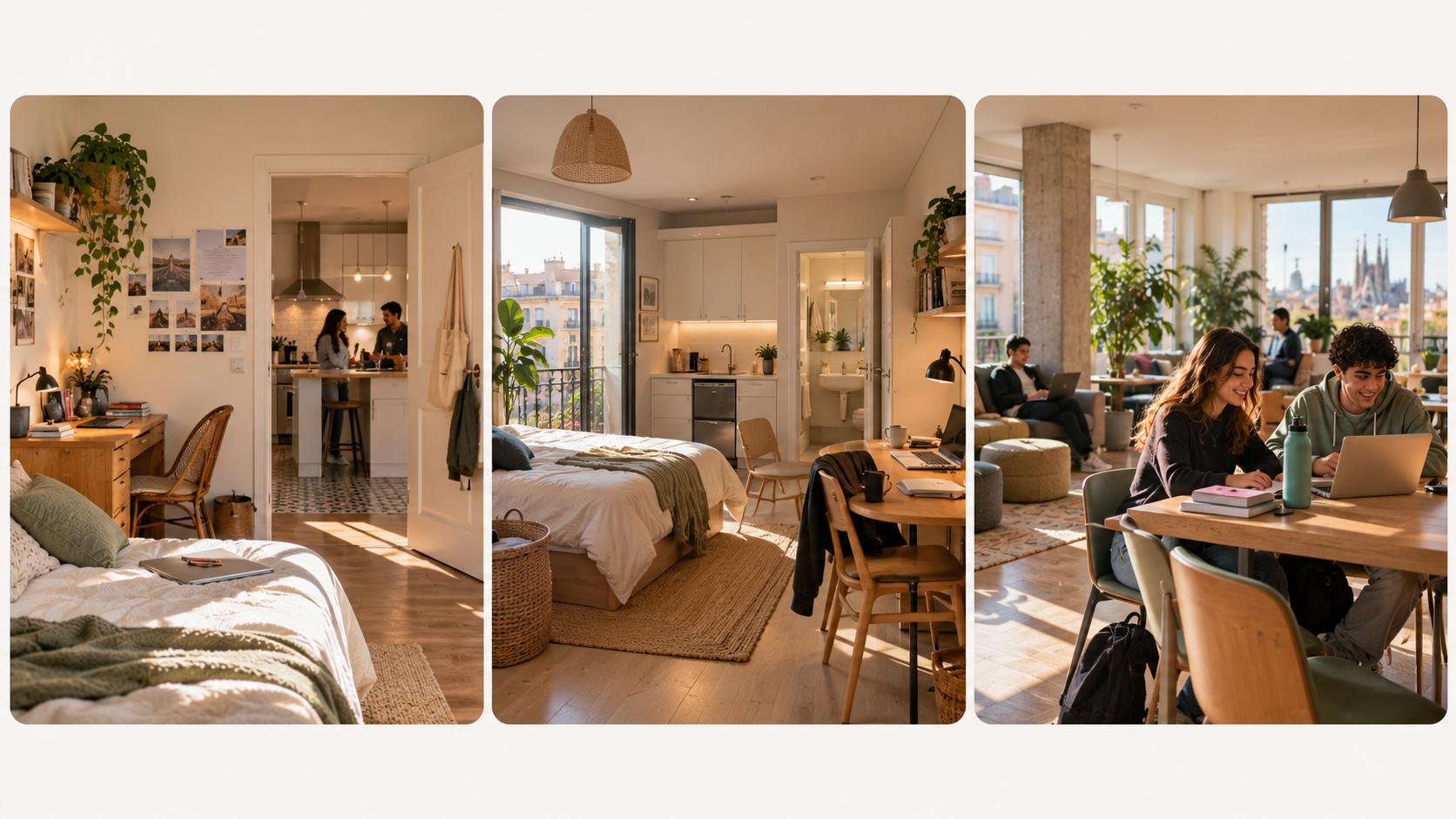
Choosing student housing in Barcelona takes more than comparing monthly rent. A room in a shared apartment, a private studio, and a student residence can each work well, but only if the space, total cost, location, and contract fit your stay.
Start with the essentials: your arrival and departure dates, the campus you’ll attend, the privacy you need, and the amount you can commit upfront. Then compare each option against the same criteria. A lower advertised rate is not necessarily a lower-cost stay, and a longer list of amenities does not mean you’ll use them all.
Room, studio, or student residence: understand what you’re booking
The key distinction is between the space you rent and the way the property is managed. A studio describes a unit. A student residence describes a managed housing setting, which may contain several types of units.
- Room in a shared apartment: You rent a bedroom and share some facilities, usually a kitchen, living area, or bathroom. Confirm whether the bedroom is exclusively yours, how many people occupy the apartment, and which facilities are shared.
- Private studio: You rent a self-contained unit with a sleeping area, a private bathroom, and a kitchen or kitchenette. Check the actual layout and equipment, including cooking facilities, storage, and a suitable place to study.
- Student residence: You book a room, bed, or studio within a managed student housing property. Room types, services, shared facilities, and house rules vary by residence.
These categories overlap. A studio inside a student residence may offer private living space alongside shared facilities and building-wide rules. A private bedroom in a shared apartment is not the same as a shared bedroom.
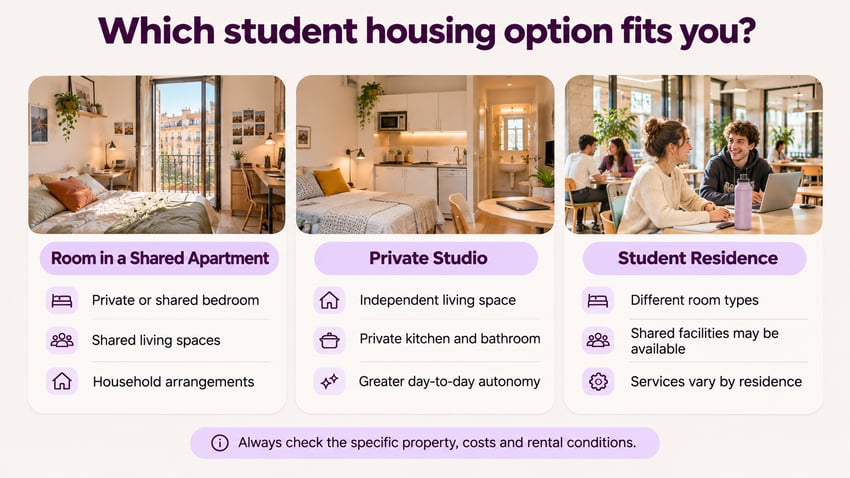
Compare the specific unit and contract, not the listing label. No housing category automatically guarantees flexibility, included services, or a problem-free stay.
Compare the full cost, not just monthly rent
Use the same dates for every option and calculate what you would pay across the entire required contract period. Keep nonrefundable expenses separate from refundable deposits and other upfront payments. Check each of the following:
- Rent and billing periods: Confirm the number of months or days charged, including any mandatory periods before arrival or after departure.
- Utilities and internet: Ask what is included, whether usage caps apply, and how additional or shared consumption is billed.
- Cleaning: Separate common-area cleaning, room cleaning, and end-of-stay cleaning. They may be charged differently.
- Administrative charges: Request an itemized explanation of each charge, its amount, and why it applies. If a fee is unclear, seek clarification or qualified advice before accepting it.
- Services: Identify mandatory charges and optional extras, such as laundry or meal plans. An available service is not necessarily an included service.
- Transportation: Add the cost of the journeys your routine will require.
Total stay cost: rent for the required period + utilities not included + applicable nonrefundable fees + mandatory and selected optional services + transportation
Count each expense once. Do not add a booking payment again if it is credited toward rent. Record refundable deposits separately: they affect the cash you need upfront, even though they are not necessarily a final expense. Review the conditions and process for their return.
Check how the space supports daily life
The right arrangement depends on how you study, cook, rest, and share space. Shared housing does not automatically mean conflict, and a student residence does not guarantee an active social life.
In a shared apartment: Ask how many people use each bathroom, how kitchen storage is divided, and what expectations apply to cleaning and noise. Check whether your room has a desk, adequate lighting, and enough storage, rather than assuming you can study comfortably in a common area. Clarify how shared bills are managed and what happens when someone moves in or out. Practical agreements matter as much as the apartment’s appearance.
In a private studio: Look beyond the promise of independence. Check whether the kitchenette supports the meals you plan to prepare, whether the desk is usable, and whether the layout gives you enough room for everyday activities. Private space does not guarantee quiet. Consider the building, neighboring units, street activity, and any available information about sound insulation.
In a student residence: Review the facilities you expect to use, including study rooms, kitchens, laundry areas, and social spaces. Confirm opening hours, access rules, availability, and additional charges. For every option, read the rules on visitors, overnight guests, noise, cleaning, and shared facilities. A daytime visitor and an overnight guest may be subject to different conditions.
Assess location against your actual campus
“Near a university” is not enough. Check the address of the building where your classes, research, or internship will take place, especially if your program uses multiple locations. Compare:
- Door-to-door travel time: Include walking, waiting, transfers, and the final stretch to your destination.
- Service hours: Check journeys at the times you’ll actually travel, including early classes and late returns.
- Weekly frequency: A commute made twice a week has a different impact from one made every day.
- Daily essentials: Locate grocery stores, pharmacies, libraries, and suitable study spaces.
- Transportation costs: Verify current fares, route coverage, and pass eligibility rather than assuming a student discount applies.
A location farther from campus may still suit your routine if the connection is reliable. Compare any rent savings with travel costs and time. A central address is not automatically the most practical one.
Match the contract to the length of your stay
Your schedule does not determine which housing category is best. It determines which contracts you should rule out.
| Type of stay | What to Compare Among the Three Options |
|---|---|
| One semester | Coverage for orientation and exams, minimum contract length, and any charged periods you won’t use. |
| Full academic year | Access during breaks, the full contracted term, any provisions for fee changes, and renewal conditions. |
| Internships | Alignment with the host organization’s schedule and the terms if the placement ends early or is extended. |
| Exchange with fixed dates | Exact move-in and move-out dates, key collection and return times, and any gap requiring temporary housing. |
Before booking, distinguish between cancellation before arrival, early departure after moving in, and an extension beyond the original term. Each may have separate conditions, charges, and procedures. Confirm notice requirements, contractual obligations, and the deposit return process in writing. Do not assume an extension will be available or that moving out early ends your payment obligations.
Choose based on priorities and trade-offs
First eliminate options that do not fit your dates, total budget, or essential requirements. Then compare the practical trade-offs.
- For privacy and independence: Consider a studio with a private bathroom, suitable cooking facilities, and a usable study area. You’ll need to cover the unit’s cost without sharing it and confirm that the layout works for daily life.
- For share living and expenses: Consider a private room in a shared apartment. Check the bill-sharing arrangement, household expectations, and access to the kitchen and bathroom. Lower individual costs may come with more coordination.
- For managed facilities and opportunities to meet other students: Consider a student residence with services you’ll actually use. Review its rules, access hours, and extras rather than assuming everything is included.
For a short exchange, date compatibility may be decisive. For an academic year, continuity and a sustainable routine may matter more. If two options meet your essentials, compare the full-cost and usable benefits, not the length of the amenities list.
Find housing in Barcelona with Floweal Go
Floweal Go connects housing search and booking with the wider international mobility experience. It brings accommodation, digital contracts, payments, communication, and access to related services into the same flow.
The booking decision still depends on the specific offer: dates, unit type, total charges, included services, and contract terms. Availability varies, so confirm which rooms, studios, or student residence options are offered for your stay before making plans around them. Where additional services are available, check their scope and booking conditions separately. Do not assume transfers, local assistance, or other support are included with every accommodation.
Start with your dates, campus, and privacy requirements. Then compare available options using the same checklist before committing.
Frequently Asked Questions
-
Is a room in a shared apartment or a studio better for students in Barcelona? A private room in a shared apartment may suit students who are comfortable sharing facilities and household responsibilities. A studio may be a better fit when a private bathroom and cooking space are priorities. Compare the total cost and daily setup. A bedroom with a private bathroom can offer additional privacy without being a self-contained studio.
-
What is included in student residence fees? Inclusions vary by property and booking. Utilities, internet, or cleaning may be included, while laundry, meals, or other services may cost extra. Request a written breakdown and check usage limits. Distinguish between amenities you can access and services covered by the fee.
-
Can I rent a student room in Barcelona for one semester? It depends on availability, minimum stay requirements, and the individual contract. Confirm dates that cover orientation, classes, and exams, along with the full period you must pay for. A room marketed to students does not necessarily have a contract that follows your academic calendar.
-
What should I check before booking a room in shared housing? Confirm the exact bedroom, whether it is private or shared, the number of occupants, and access to bathrooms and cooking facilities. Review how bills, cleaning, and household responsibilities are divided. Clarify whether your agreement covers only the room or creates obligations relating to the wider apartment.
-
How can I compare the total cost of different housing options? Use identical dates and include rent for the required term, utilities not included, applicable nonrefundable charges, mandatory and selected optional services, and transportation. List refundable deposits separately as upfront cash requirements. Check for mandatory payments covering periods when you will not be staying there.
-
Which housing option offers the most privacy? A studio for exclusive use generally provides a private sleeping area, bathroom, and cooking space within one unit. A private room gives you exclusive use of the bedroom, while other facilities may be shared. In a student residence, privacy depends on the unit booked. None of these arrangements guarantees soundproofing or an absence of noise.
We make it flow.
Explore this topic